Ch. 22 - Conjugated Systems 2: Pericyclic Reactions
Mullins - Organic Chemistry: A Learner Centered Approach 1st Edition
Mullins1st EditionOrganic Chemistry: A Learner Centered ApproachISBN: 9780137566471Non è quello che usi tu?Cambia libro di testo
Capitolo 21, Problema 14

Figure 22.16(a) <IMAGE> shows a unique example where the Diels–Alder reaction gives a single product (no enantiomers) regardless of whether the diene attacks the dienophile from the top or bottom.
(a) Show the product of the diene attacking from the bottom and confirm that the same product is obtained.
(b) What is special about this product that makes this true?

Guida verificata passo dopo passo
1
Identify the diene and dienophile involved in the Diels–Alder reaction. The diene is a conjugated system with two double bonds, and the dienophile is typically an alkene or alkyne with electron-withdrawing groups.
Draw the diene and dienophile in their correct orientations. For the diene, ensure that the p orbitals are aligned to allow for the formation of new sigma bonds. For the dienophile, position it so that it can interact with the diene.
Consider the approach of the diene to the dienophile from the bottom. In a Diels–Alder reaction, the diene and dienophile undergo a concerted cycloaddition to form a six-membered ring. Draw the transition state where the new sigma bonds are forming.
Complete the cycloaddition by forming the new sigma bonds between the diene and dienophile. This will result in a cyclohexene ring. Ensure that the stereochemistry is consistent with the approach from the bottom.
Analyze the product to determine why it is unique. The product is likely symmetrical or has a plane of symmetry, which results in the same product regardless of the approach direction. This symmetry prevents the formation of enantiomers, leading to a single product.

Risposta video verificata per un problema simile:

Questa soluzione video è stata consigliata dai nostri tutor come utile per risolvere questo problema.

Concetti chiave

Ecco i concetti essenziali che devi comprendere per rispondere correttamente alla domanda.

Diels–Alder Reaction

The Diels–Alder reaction is a [4+2] cycloaddition between a conjugated diene and a dienophile, forming a six-membered ring. It is a pericyclic reaction that proceeds via a concerted mechanism, often used to synthesize complex cyclic structures. Understanding the stereochemistry and regiochemistry of the reactants is crucial for predicting the product.
Video consigliato:
04:02
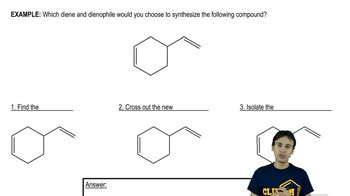
Diels-Alder Retrosynthesis

Stereochemistry

Stereochemistry involves the study of the spatial arrangement of atoms in molecules and its impact on chemical reactions. In the Diels–Alder reaction, the orientation of the diene and dienophile can lead to different stereoisomers. However, certain symmetrical or constrained systems can lead to a single stereochemical outcome, as seen in the given example.
Video consigliato:
Percorso guidato
1:38
Polymer Stereochemistry Concept 1

Symmetry in Organic Molecules

Symmetry in organic molecules can lead to unique chemical behavior, such as producing a single product in reactions that typically yield multiple stereoisomers. In the context of the Diels–Alder reaction, symmetry in the diene or dienophile can result in identical products regardless of the approach direction, due to equivalent spatial arrangements.
Video consigliato:
02:17
Identifying organic molecules