Ch. 22 - Conjugated Systems 2: Pericyclic Reactions
Mullins - Organic Chemistry: A Learner Centered Approach 1st Edition
Mullins1st EditionOrganic Chemistry: A Learner Centered ApproachISBN: 9780137566471Non è quello che usi tu?Cambia libro di testo
Capitolo 21, Problema 30b

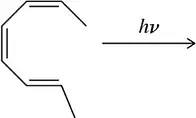
Predict the product of the following electrocyclic reactions.
(b) Chemical structure illustrating an electrocyclic reaction with light energy input, showing reactants and reaction arrow.

Guida verificata passo dopo passo
1
Identify the type of electrocyclic reaction: The image shows a conjugated polyene undergoing an electrocyclic reaction under photochemical conditions (indicated by 'hv'). This suggests a ring closure process.
Determine the number of π electrons involved: Count the π electrons in the conjugated system. The structure has 6 π electrons, which is typical for a thermal or photochemical electrocyclic reaction.
Apply Woodward-Hoffmann rules: For photochemical reactions, the electrocyclic closure of a system with 4n+2 π electrons (where n is an integer) proceeds via a conrotatory mechanism.
Visualize the conrotatory motion: In a conrotatory mechanism, the terminal ends of the π system rotate in the same direction (either both clockwise or both counterclockwise) to form a new σ bond, resulting in a change in the stereochemistry of the product.
Predict the stereochemistry of the product: Based on the conrotatory motion, determine the stereochemistry of the newly formed ring. The product will have a specific stereochemical configuration due to the conrotatory closure.

Risposta video verificata per un problema simile:

Questa soluzione video è stata consigliata dai nostri tutor come utile per risolvere questo problema.

Concetti chiave

Ecco i concetti essenziali che devi comprendere per rispondere correttamente alla domanda.

Electrocyclic Reactions

Electrocyclic reactions are a type of pericyclic reaction where a conjugated pi-electron system undergoes a ring closure or opening. These reactions are characterized by the concerted movement of electrons, leading to the formation or breaking of a sigma bond. The stereochemistry of the product is determined by the number of pi electrons and whether the reaction is thermally or photochemically induced.
Video consigliato:
08:11
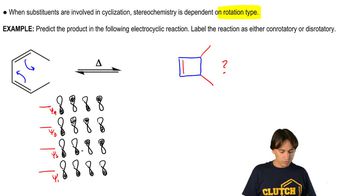
Predicting Electrocyclic Products

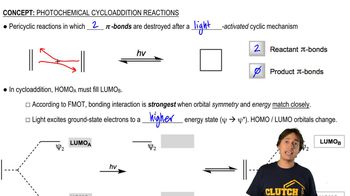
Photochemical Activation

Photochemical activation involves the absorption of light (hv) to promote electrons to a higher energy state, facilitating reactions that might not occur under thermal conditions. In electrocyclic reactions, light can induce a change in the electron configuration, often leading to different stereochemical outcomes compared to thermal activation. This is crucial for determining the stereochemistry of the product in the given reaction.
Video consigliato:
09:36
MO Theory of Photochemical Cycloadditions

Woodward-Hoffmann Rules

The Woodward-Hoffmann rules predict the stereochemistry of pericyclic reactions, including electrocyclic reactions, based on the conservation of orbital symmetry. For photochemical reactions, these rules state that reactions involving 4n pi electrons proceed via a conrotatory mechanism, while those with 4n+2 pi electrons proceed via a disrotatory mechanism. Understanding these rules helps predict the stereochemical outcome of the reaction depicted in the image.
Video consigliato:
Percorso guidato
1:18
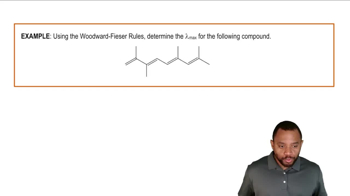
Woodward-Fieser Rules Example 1