Ch. 23 - Benzene 1: Aromatic Stability and Substitution Reactions
Mullins - Organic Chemistry: A Learner Centered Approach 1st Edition
Mullins1st EditionOrganic Chemistry: A Learner Centered ApproachISBN: 9780137566471Non è quello che usi tu?Cambia libro di testo
Capitolo 22, Problema 16d

(i) Classify the following molecules as aromatic, nonaromatic, or antiaromatic.
(ii) For the aromatic and antiaromatic molecules, solve for n in Hückel’s/Breslow’s rule. For the other molecules, explain which of the rules of aromaticity is being broken.
(d) Chemical structure of a pentagonal ring with a positive charge, used for classifying aromaticity in molecules.

Guida verificata passo dopo passo
1
Identify the molecule structure: The image shows a cyclopentadienyl cation, which is a five-membered ring with two double bonds and a positive charge.
Determine the number of π electrons: Count the π electrons in the molecule. Each double bond contributes two π electrons, so there are 4 π electrons in total.
Apply Hückel's rule: Hückel's rule states that a molecule is aromatic if it has (4n + 2) π electrons, where n is a non-negative integer. Check if the molecule fits this rule.
Evaluate antiaromaticity: If the molecule has 4n π electrons, it is considered antiaromatic. Check if the molecule fits this condition.
Classify the molecule: Based on the number of π electrons and the application of Hückel's rule, classify the molecule as aromatic, nonaromatic, or antiaromatic. In this case, the cyclopentadienyl cation with 4 π electrons is antiaromatic.

Risposta video verificata per un problema simile:

Questa soluzione video è stata consigliata dai nostri tutor come utile per risolvere questo problema.

Concetti chiave

Ecco i concetti essenziali che devi comprendere per rispondere correttamente alla domanda.

Aromaticity

Aromaticity refers to the special stability and unique properties of cyclic compounds that follow Hückel's rule, which states that a molecule is aromatic if it has (4n + 2) π electrons, where n is a non-negative integer. Aromatic compounds are typically planar, fully conjugated, and exhibit resonance, leading to lower energy and increased stability compared to non-aromatic compounds.
Video consigliato:
08:19
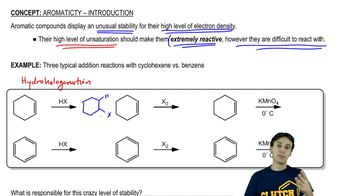
Intro to Aromaticity

Anti-aromaticity

Anti-aromaticity describes compounds that are cyclic, planar, and fully conjugated but contain 4n π electrons, which leads to instability. These compounds are less stable than their non-aromatic counterparts due to the presence of destabilizing interactions among the π electrons, making them highly reactive and less favorable in chemical reactions.
Video consigliato:
03:19
The Anti-Coplanar Requirement

Hückel's Rule

Hückel's Rule is a criterion used to determine the aromaticity of a compound based on its π electron count. According to this rule, a planar, cyclic molecule is aromatic if it contains (4n + 2) π electrons. Conversely, if it contains 4n π electrons, it is classified as anti-aromatic. This rule is essential for classifying the stability and reactivity of cyclic compounds in organic chemistry.
Video consigliato:
03:54
The 18 and 16 Electron Rule