Ch. 23 - Benzene 1: Aromatic Stability and Substitution Reactions
Mullins - Organic Chemistry: A Learner Centered Approach 1st Edition
Mullins1st EditionOrganic Chemistry: A Learner Centered ApproachISBN: 9780137566471Non è quello che usi tu?Cambia libro di testo
Capitolo 22, Problema 53c

Predict the products of the following nucleophilic aromatic substitution reactions.
(c) Chemical structure illustrating nucleophilic aromatic substitution with a strong base, NaH, indicated by an arrow.

Guida verificata passo dopo passo
1
Identify the type of reaction: This is a nucleophilic aromatic substitution (NAS) reaction, which typically involves the replacement of a leaving group (such as Cl) on an aromatic ring by a nucleophile.
Recognize the role of the strong base: Sodium hydride (NaH) is a strong base that will deprotonate the alcohol group, forming an alkoxide ion. This alkoxide ion will act as the nucleophile in the reaction.
Determine the position of substitution: In NAS reactions, the nucleophile will attack the carbon atom that is ortho or para to an electron-withdrawing group, such as the ester group in this molecule. The chlorine atom is ortho to the ester group, making it a suitable leaving group.
Consider the mechanism: The alkoxide ion will attack the aromatic ring at the position of the chlorine atom, leading to the displacement of the chlorine and formation of a new C-O bond.
Predict the product: The final product will be an aromatic compound where the chlorine atom has been replaced by the alkoxide group, resulting in an ether linkage between the aromatic ring and the alkoxide group.

Risposta video verificata per un problema simile:

Questa soluzione video è stata consigliata dai nostri tutor come utile per risolvere questo problema.

Concetti chiave

Ecco i concetti essenziali che devi comprendere per rispondere correttamente alla domanda.

Nucleophilic Aromatic Substitution

Nucleophilic aromatic substitution involves the replacement of a leaving group, such as a halide, on an aromatic ring by a nucleophile. This reaction typically requires strong electron-withdrawing groups on the ring to stabilize the intermediate. The reaction proceeds through either an addition-elimination mechanism or a benzyne mechanism, depending on the conditions and substrates involved.
Video consigliato:
01:47
Nucleophiles and Electrophiles can react in Substitution Reactions.

Role of Strong Bases

Strong bases, like sodium hydride (NaH), are used to deprotonate nucleophiles, enhancing their nucleophilicity. In nucleophilic aromatic substitution, a strong base can generate a negatively charged nucleophile, which is more reactive towards the electrophilic aromatic ring. This increased reactivity is crucial for facilitating the substitution process, especially when the aromatic ring is not highly activated.
Video consigliato:
03:10
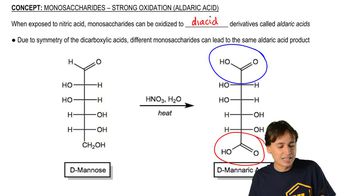
Monosaccharides - Strong Oxidation (Aldaric Acid)

Leaving Group Ability

The leaving group ability is a critical factor in nucleophilic aromatic substitution reactions. Chlorine, as a halide, is a common leaving group due to its ability to stabilize the negative charge upon departure. The effectiveness of a leaving group is influenced by its electronegativity and the stability of the resulting anion, which impacts the overall rate and feasibility of the substitution reaction.
Video consigliato:
03:06
How to use the factors affecting acidity to predict leaving group ability.