Ch. 24 - Benzene 2: Reactions Influenced by the Aromatic Ring
Mullins - Organic Chemistry: A Learner Centered Approach 1st Edition
Mullins1st EditionOrganic Chemistry: A Learner Centered ApproachISBN: 9780137566471Non è quello che usi tu?Cambia libro di testo
Capitolo 23, Problema 34g

Predict the product(s) of the following reactions.
(g) Chemical reaction diagram showing brominated compounds reacting with sodium cyanide in THF solvent.

Guida verificata passo dopo passo
1
Step 1: Analyze the reactants and reagents. The starting material is a molecule with two bromine atoms attached to a benzyl group. The reagent is sodium cyanide (NaCN) in tetrahydrofuran (THF), which is a polar aprotic solvent. NaCN is a nucleophile that can perform substitution reactions.
Step 2: Determine the type of reaction. Since NaCN is a strong nucleophile and THF is a polar aprotic solvent, the reaction is likely to proceed via an SN2 mechanism. In an SN2 reaction, the nucleophile attacks the electrophilic carbon directly, displacing the leaving group (Br) in a single step.
Step 3: Identify the electrophilic centers. The two bromine atoms are attached to secondary carbons, making them both potential sites for nucleophilic attack. However, since only 1 equivalent of NaCN is used, the reaction will occur at one of the bromine atoms.
Step 4: Consider steric and electronic factors. The bromine atom attached to the benzylic position is more reactive due to resonance stabilization of the transition state. Therefore, NaCN will preferentially attack the benzylic carbon, displacing the bromine atom and forming a benzylic nitrile.
Step 5: Predict the product. The product will be a molecule where the benzylic bromine is replaced by a cyanide group (-CN), while the other bromine atom remains unchanged. The stereochemistry at the benzylic carbon will invert due to the SN2 mechanism.

Risposta video verificata per un problema simile:

Questa soluzione video è stata consigliata dai nostri tutor come utile per risolvere questo problema.
Durata del video:
1m

Concetti chiave

Ecco i concetti essenziali che devi comprendere per rispondere correttamente alla domanda.

Nucleophilic Substitution Reactions

Nucleophilic substitution reactions involve the replacement of a leaving group (like bromine) by a nucleophile (such as cyanide ions). In this case, sodium cyanide (NaCN) acts as the nucleophile, attacking the carbon atom bonded to the bromine, leading to the formation of a new carbon-nitrogen bond.
Video consigliato:
01:47
Nucleophiles and Electrophiles can react in Substitution Reactions.

SN2 Mechanism

The SN2 mechanism is a type of nucleophilic substitution that occurs in a single concerted step, where the nucleophile attacks the electrophile from the opposite side of the leaving group. This results in an inversion of configuration at the carbon center. The reaction shown likely follows this mechanism due to the presence of primary and secondary carbon centers.
Video consigliato:
08:33
Drawing the SN2 Mechanism

Solvent Effects in Organic Reactions

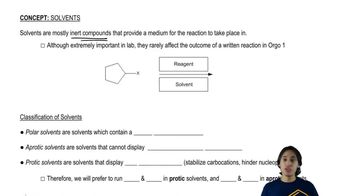
The choice of solvent can significantly influence the outcome of organic reactions. Tetrahydrofuran (THF) is a polar aprotic solvent that stabilizes cations and enhances nucleophilicity, making it suitable for SN2 reactions. In this reaction, THF helps facilitate the nucleophilic attack by sodium cyanide on the brominated compound.
Video consigliato:
02:26
General format of reactions and how to interpret solvents.