Ch. 27 - Carbohydrates, Nucleic Acids, and Lipids
Mullins - Organic Chemistry: A Learner Centered Approach 1st Edition
Mullins1st EditionOrganic Chemistry: A Learner Centered ApproachISBN: 9780137566471Non è quello che usi tu?Cambia libro di testo
Capitolo 26, Problema 30b

Predict the product of the following etherification reactions.
(b) Chemical structure of a monosaccharide with hydroxyl groups, showing etherification reaction with reagents and product prediction.

Guida verificata passo dopo passo
1
Identify the functional groups present in the starting material. The molecule is a sugar derivative with multiple hydroxyl (OH) groups and an allyl ether group.
Recognize the reagents used in the reaction. The reagent is trimethylsilyl chloride ((CH₃)₃SiCl) in excess, along with triethylamine (Et₃N) in excess.
Understand the role of the reagents. Trimethylsilyl chloride is used to protect hydroxyl groups by converting them into trimethylsilyl ethers, which are less reactive. Triethylamine acts as a base to facilitate the reaction.
Predict the reaction outcome. The excess of trimethylsilyl chloride will likely convert all the hydroxyl groups into trimethylsilyl ethers, protecting them from further reactions.
Consider the stereochemistry and regioselectivity. Since all hydroxyl groups are converted to silyl ethers, the stereochemistry of the sugar ring remains unchanged, and the allyl ether group is unaffected by the silylation process.

Risposta video verificata per un problema simile:

Questa soluzione video è stata consigliata dai nostri tutor come utile per risolvere questo problema.
Durata del video:
1m

Concetti chiave

Ecco i concetti essenziali che devi comprendere per rispondere correttamente alla domanda.

Etherification Reaction

Etherification is a chemical reaction that forms an ether from an alcohol and an alkylating agent. In this reaction, the hydroxyl groups (OH) of the alcohol are replaced by an alkoxy group (OR), typically using a reagent like an alkyl halide. Understanding the mechanism of etherification is crucial for predicting the product, as it involves the substitution of the hydroxyl group with an ether linkage.
Video consigliato:
05:09
Heck Reaction

Silyl Ether Protection

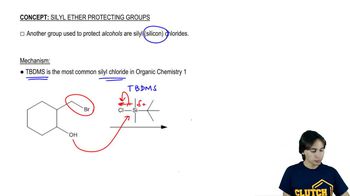
Silyl ether protection involves the conversion of hydroxyl groups into silyl ethers using reagents like chlorotrimethylsilane (TMSCl) in the presence of a base such as triethylamine (Et3N). This reaction is used to protect alcohols from unwanted reactions by forming a stable silyl ether, which can be removed later. In the given reaction, excess (CH3)3SiCl suggests the formation of silyl ethers, protecting the hydroxyl groups.
Video consigliato:
07:16
Mechanism of Silyl Ether Protecting Groups.

Role of Triethylamine

Triethylamine (Et3N) acts as a base in organic reactions, often used to neutralize acids formed during reactions or to facilitate the deprotonation of alcohols. In the context of silyl ether formation, Et3N helps in the deprotonation of the hydroxyl group, allowing the silyl chloride to react and form the silyl ether. Its presence in excess ensures complete conversion of all hydroxyl groups to silyl ethers.
Video consigliato:
05:09
Heck Reaction