Ch. 27 - Carbohydrates, Nucleic Acids, and Lipids
Mullins - Organic Chemistry: A Learner Centered Approach 1st Edition
Mullins1st EditionOrganic Chemistry: A Learner Centered ApproachISBN: 9780137566471Non è quello che usi tu?Cambia libro di testo
Capitolo 26, Problema 68

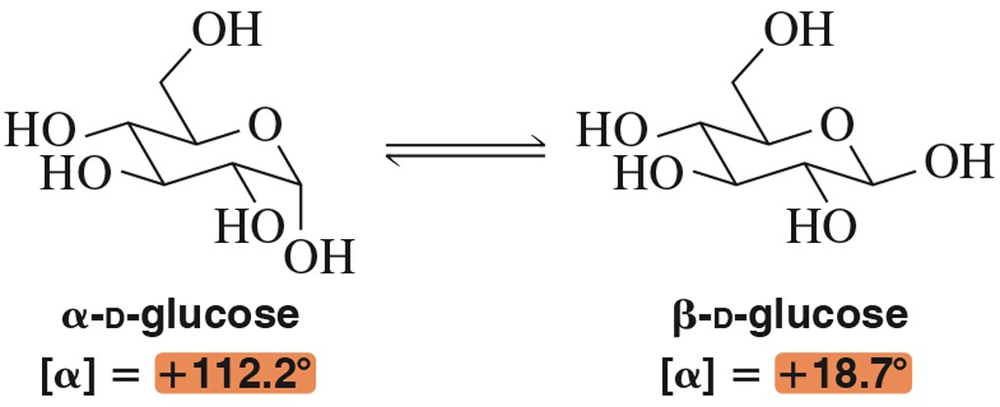
The α- and β-anomers of glucose are shown here. In solution, these two epimers can interconvert through a process called mutarotation.
Structures of α-D-glucose and β-D-glucose with their specific rotations, illustrating mutarotation.
Given that α-D-glucose has a specific rotation of + 112.2° , why is the specific rotation of β-D-glucose not -112.2°? What molecule would have a specific rotation of -112.2°?

Guida verificata passo dopo passo
1
Understand the concept of mutarotation: Mutarotation is the process by which the α- and β-anomers of a sugar interconvert in aqueous solution through the open-chain form of the sugar. This results in a change in the specific rotation of the solution until equilibrium is reached.
Recognize that the specific rotation of a compound is an intrinsic property that depends on its molecular structure. The specific rotation of α-d-glucose is +112.2°, but the specific rotation of β-d-glucose is not simply the negative of this value because the two anomers are not mirror images of each other (they are epimers, differing only at the anomeric carbon).
Recall that a molecule with a specific rotation of -112.2° would need to be the enantiomer of α-d-glucose. Enantiomers are non-superimposable mirror images of each other, and they have specific rotations that are equal in magnitude but opposite in sign.
Identify the enantiomer of α-d-glucose: The enantiomer of α-d-glucose is α-l-glucose. This molecule would have a specific rotation of -112.2° because it is the mirror image of α-d-glucose.
Conclude that β-d-glucose is not the enantiomer of α-d-glucose, but rather an epimer. Therefore, its specific rotation is not simply the negative of +112.2°. Instead, β-d-glucose has its own specific rotation value, which is determined experimentally.

Risposta video verificata per un problema simile:

Questa soluzione video è stata consigliata dai nostri tutor come utile per risolvere questo problema.

Concetti chiave

Ecco i concetti essenziali che devi comprendere per rispondere correttamente alla domanda.

Anomers

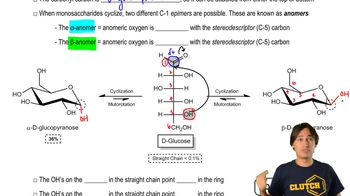
Anomers are a type of stereoisomer found in carbohydrates, specifically cyclic forms of sugars. They differ at the anomeric carbon, which is the carbon atom that becomes a new chiral center when a sugar cyclizes. In the case of glucose, the α- and β-anomers differ in the orientation of the hydroxyl group (-OH) at the anomeric carbon, leading to distinct physical properties, including specific rotation.
Video consigliato:
12:58
Monosaccharides - Cyclization

Specific Rotation

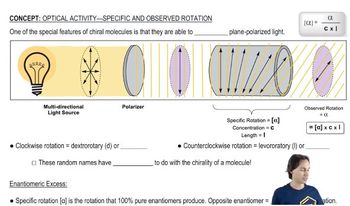
Specific rotation is a measure of how much a chiral compound can rotate plane-polarized light, expressed in degrees. It is influenced by the molecular structure and the concentration of the solution. Each anomer of glucose has a unique specific rotation due to differences in their spatial arrangement, which affects how they interact with light. The specific rotation is not simply the negative of the other anomer's value because it depends on the overall molecular configuration.
Video consigliato:
05:43
Specific rotation vs. observed rotation.

Mutarotation

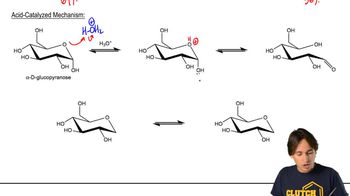
Mutarotation is the process by which anomeric forms of a sugar interconvert in solution, leading to a change in optical rotation over time. This occurs as the sugar equilibrates between its α and β forms, which can be influenced by factors such as temperature and concentration. The specific rotation of a mixture of anomers will stabilize at a value that reflects the proportions of each form present, rather than being a simple average of their individual rotations.
Video consigliato:
03:06
Mechanism