Ch. 3 - Alkanes and Cycloalkanes: Properties and Conformational Analysis
Mullins - Organic Chemistry: A Learner Centered Approach 1st Edition
Mullins1st EditionOrganic Chemistry: A Learner Centered ApproachISBN: 9780137566471Non è quello che usi tu?Cambia libro di testo
Capitolo 2, Problema 30

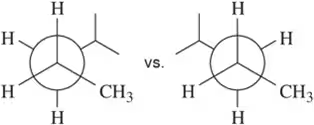
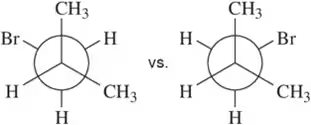
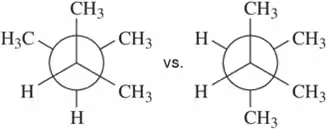
For each of the pairs in Assessment 3.29, which conformation would you expect to be more prominent at equilibrium?
(a)
(b)
(c) Newman projections comparing two conformations of a cycloalkane with labeled carbon and hydrogen atoms.

Guida verificata passo dopo passo
1
Identify the pairs of conformations provided in the problem. These are typically different spatial arrangements of the same molecule, such as chair conformations of cyclohexane or staggered/eclipsed conformations of alkanes.
Determine the steric and electronic factors that influence the stability of each conformation. For example, in cyclohexane chair conformations, bulky substituents prefer the equatorial position to minimize 1,3-diaxial interactions.
Analyze the energy differences between the conformations. For staggered and eclipsed conformations, consider torsional strain (caused by eclipsing bonds) and steric hindrance (caused by bulky groups being too close).
Apply the principle of equilibrium: the more stable conformation (lower energy) will be more prominent at equilibrium. Use the factors identified in the previous steps to predict which conformation is more stable.
Summarize your findings for each pair of conformations, explaining why one is more prominent at equilibrium based on steric hindrance, torsional strain, or other relevant factors.

Risposta video verificata per un problema simile:

Questa soluzione video è stata consigliata dai nostri tutor come utile per risolvere questo problema.
Durata del video:
1m

Concetti chiave

Ecco i concetti essenziali che devi comprendere per rispondere correttamente alla domanda.

Conformational Analysis

Conformational analysis involves studying the different spatial arrangements of atoms in a molecule that can be interconverted by rotation around single bonds. These conformations can have varying degrees of stability due to steric interactions and torsional strain. Understanding which conformation is more stable helps predict the predominant form at equilibrium.
Video consigliato:
03:29
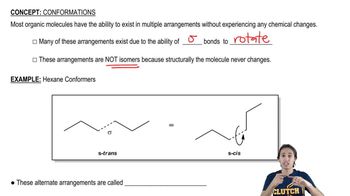
Understanding what a conformer is.

Stability Factors

The stability of a conformation is influenced by several factors, including steric hindrance, torsional strain, and electronic interactions. Steric hindrance occurs when atoms are forced close together, leading to repulsion, while torsional strain arises from eclipsed interactions. Evaluating these factors allows chemists to determine which conformation is favored in a given situation.
Video consigliato:
03:43
The radical stability trend.

Equilibrium and Thermodynamics

Equilibrium in chemistry refers to the state where the rates of the forward and reverse reactions are equal, resulting in constant concentrations of reactants and products. In the context of conformations, the more stable conformation will be present in greater amounts at equilibrium, reflecting the thermodynamic favorability of that state. Understanding this concept is crucial for predicting the predominant conformation in a molecular system.
Video consigliato:
04:00
Determining Acid/Base Equilibrium