
Ch. 3 - Alkanes and Cycloalkanes: Properties and Conformational Analysis
Mullins - Organic Chemistry: A Learner Centered Approach 1st Edition
Mullins1st EditionOrganic Chemistry: A Learner Centered ApproachISBN: 9780137566471Non è quello che usi tu?Cambia libro di testo
Capitolo 2, Problema 46f

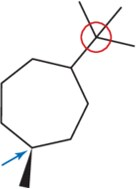
Given the line-angle drawings shown, answer the following questions:
(i) How many carbons are in each molecule?
(ii) How many hydrogens are at the circled carbon?
(iii) Is the indicated (→) carbon or 1° , 2°, 3°, or 4°?
(f) Line-angle drawing of a molecule with a circled carbon and an arrow indicating another carbon, highlighting structural features.

Guida verificata passo dopo passo
1
Step 1: Analyze the line-angle drawing provided. In line-angle drawings, each vertex represents a carbon atom, and lines represent bonds between atoms. Count the number of vertices to determine the total number of carbon atoms in the molecule.
Step 2: Identify the circled carbon atom in the drawing. Recall that each carbon atom forms four bonds. If the circled carbon is bonded to other carbons or hydrogens, determine the number of hydrogens by subtracting the number of bonds to other atoms from four.
Step 3: Locate the indicated (→) carbon atom in the drawing. Determine its degree (1°, 2°, 3°, or 4°) based on the number of carbon atoms directly attached to it: 1° (primary) has one carbon attached, 2° (secondary) has two carbons attached, 3° (tertiary) has three carbons attached, and 4° (quaternary) has four carbons attached.
Step 4: Verify your answers by carefully reviewing the structure and ensuring all bonds and atoms are accounted for. Double-check the number of hydrogens and the degree of the indicated carbon.
Step 5: Summarize your findings for each part of the question: (i) total number of carbons, (ii) number of hydrogens at the circled carbon, and (iii) degree of the indicated carbon.

Risposta video verificata per un problema simile:

Questa soluzione video è stata consigliata dai nostri tutor come utile per risolvere questo problema.
Durata del video:
5m

Concetti chiave

Ecco i concetti essenziali che devi comprendere per rispondere correttamente alla domanda.

Line-Angle Structures

Line-angle drawings, also known as skeletal structures, represent organic molecules in a simplified form where vertices and ends of lines indicate carbon atoms. Each carbon is assumed to have enough hydrogen atoms to satisfy its tetravalency, which is four bonds. Understanding this representation is crucial for quickly identifying the number of carbon atoms in a molecule.
Video consigliato:
02:46
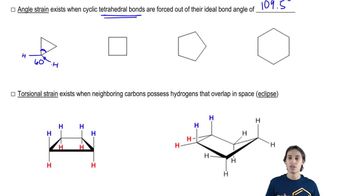
What is angle strain?

Hydrogen Atoms and Valency

In organic chemistry, each carbon atom typically forms four bonds, which can include bonds with hydrogen atoms. The number of hydrogen atoms attached to a specific carbon can vary based on its bonding environment. Recognizing how to determine the number of hydrogens at a given carbon, especially when it is circled in a drawing, is essential for answering questions about molecular structure.
Video consigliato:
03:06
Understanding the hydrogen isotopes.

Carbon Hybridization and Degree Classification

Carbons in organic molecules can be classified based on their connectivity to other carbon atoms, leading to designations such as primary (1°), secondary (2°), tertiary (3°), and quaternary (4°). This classification is determined by how many other carbon atoms are directly bonded to a given carbon. Understanding this concept is vital for assessing the reactivity and properties of the molecule in question.
Video consigliato:
10:43
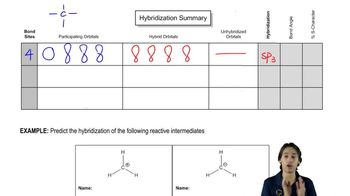
Using bond sites to predict hybridization