Ch. 3 - Alkanes and Cycloalkanes: Properties and Conformational Analysis
Mullins - Organic Chemistry: A Learner Centered Approach 1st Edition
Mullins1st EditionOrganic Chemistry: A Learner Centered ApproachISBN: 9780137566471Non è quello che usi tu?Cambia libro di testo
Capitolo 2, Problema 19c

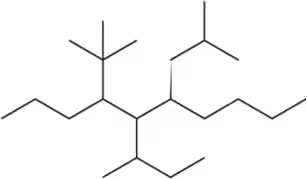
Name the following alkanes using the common names for branched substituents.
(c) Structural formula of a branched alkane with multiple carbon chains and substituents.

Guida verificata passo dopo passo
1
Identify the longest continuous carbon chain in the molecule. This will serve as the parent chain, and its name will be based on the number of carbons it contains (e.g., methane, ethane, propane, etc.).
Number the parent chain starting from the end closest to the first substituent. This ensures that the substituents receive the lowest possible numbers.
Identify and name the substituents attached to the parent chain. For branched substituents, use common names such as isopropyl, sec-butyl, tert-butyl, etc., based on their structure.
Assign a number to each substituent based on its position on the parent chain. If there are multiple substituents of the same type, use prefixes such as di-, tri-, or tetra- to indicate their quantity.
Combine the names of the substituents (in alphabetical order) with the parent chain name. Use hyphens to separate numbers from words and commas to separate numbers. Ensure the final name follows IUPAC naming conventions.

Risposta video verificata per un problema simile:

Questa soluzione video è stata consigliata dai nostri tutor come utile per risolvere questo problema.
Durata del video:
3m

Concetti chiave

Ecco i concetti essenziali che devi comprendere per rispondere correttamente alla domanda.

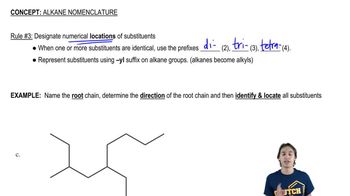
Alkane Nomenclature

Alkane nomenclature involves naming saturated hydrocarbons based on the number of carbon atoms and the structure of the molecule. The IUPAC system provides rules for naming straight-chain and branched alkanes, where the longest continuous carbon chain is identified, and substituents are named and numbered according to their position on the chain.
Video consigliato:
02:47
Functionalizing Alkanes

Branched Substituents

Branched substituents are groups that branch off the main carbon chain in an alkane. Common names for these substituents, such as methyl (–CH3), ethyl (–C2H5), and propyl (–C3H7), are used in conjunction with the main alkane name to provide a complete description of the molecule's structure.
Video consigliato:
03:07
How to identify and locate branches (substituents)

Common Naming Conventions

Common naming conventions for organic compounds often involve using familiar names rather than systematic IUPAC names. For branched alkanes, this includes recognizing and naming substituents based on their structure and position, which helps in simplifying communication about the compounds in organic chemistry.
Video consigliato:
01:20
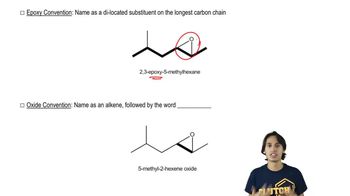
How to name epoxides using the epoxy convention.
Pratica correlata
Domanda del libro di testo

For each molecule, draw the Newman projection you would observe if you looked down the Ca - Cb bond in the direction indicated.

(d) <IMAGE>

1194
views

Domanda del libro di testo

When we begin studying reactive intermediates, the designation of substitution will be especially important. Label the following carbocations as 1° , 2°, 3°, or 4° or based on the carbon bearing the positive charge.

(b)

929
views
Domanda del libro di testo

When we begin studying functional groups, the designation of substitution will be especially important. Label the following bromoalkanes as 1° , 2°, 3°, or 4° based on the carbon to which the bromine is attached.

(b)

1300
views
Domanda del libro di testo

When we begin studying reactive intermediates, the designation of substitution will be especially important. Label the following carbocations as 1° , 2°, 3°, or 4° or based on the carbon bearing the positive charge.

(c)

1235
views
Domanda del libro di testo

Using the Newman projections shown, draw each molecule in its line-angle drawing with all hydrogens and substituents shown. [Carbon b is behind carbon a in these structures.] Wedges and dashes should be used to indicate whether a substituent is coming out of, or going into, the plane of the page.

(b)

1948
views
Domanda del libro di testo

In Chapter 8, we study the chemistry of alkenes, like ethene. In contrast to ethane, there is no free rotation around the C = C double bond of ethene. Explain this in the context of the molecular orbital picture of ethene.

970
views