Ch. 4 - Acids and Bases/Electron Flow
Mullins - Organic Chemistry: A Learner Centered Approach 1st Edition
Mullins1st EditionOrganic Chemistry: A Learner Centered ApproachISBN: 9780137566471Non è quello che usi tu?Cambia libro di testo
Capitolo 3, Problema 40e

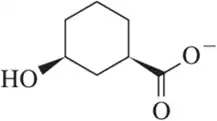
For the bases shown, draw the conjugate acid and identify a pKa value from Table 4.5 that would help you accurately estimate its stability.
(e) Chemical structure of a hexagonal ring with hydroxyl and carboxylate groups, illustrating bases and their conjugate acids.

Guida verificata passo dopo passo
1
Identify the base in the problem. A base is a species that can accept a proton (H⁺). Look for lone pairs of electrons or negative charges that can act as proton acceptors.
Draw the conjugate acid of the base by adding a proton (H⁺) to the atom in the base that has the lone pair or negative charge. Ensure proper placement of the hydrogen atom and adjust the formal charges accordingly.
Refer to Table 4.5 (or a similar pKₐ table) to find the pKₐ value of the conjugate acid. The pKₐ value provides insight into the strength of the conjugate acid and, by extension, the stability of the base.
Use the pKₐ value to estimate the stability of the base. A higher pKₐ value for the conjugate acid indicates a weaker acid, which corresponds to a more stable base. Conversely, a lower pKₐ value indicates a stronger acid and a less stable base.
Compare the stability of the base with other bases if needed, using the pKₐ values of their conjugate acids as a reference. This will help you rank the bases in terms of stability or reactivity.

Risposta video verificata per un problema simile:

Questa soluzione video è stata consigliata dai nostri tutor come utile per risolvere questo problema.
Durata del video:
1m

Concetti chiave

Ecco i concetti essenziali che devi comprendere per rispondere correttamente alla domanda.

Conjugate Acids and Bases

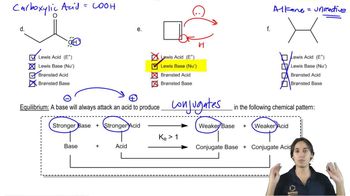
In acid-base chemistry, a conjugate acid is formed when a base accepts a proton (H⁺). Understanding this concept is crucial for predicting the behavior of substances in reactions. For example, when ammonia (NH₃) acts as a base, it can accept a proton to form its conjugate acid, ammonium (NH₄⁺). This relationship helps in determining the strength of acids and bases.
Video consigliato:
02:11
Equilibrium constant and conjugates.

pKₐ and Acid Strength

The pKₐ value is a quantitative measure of the strength of an acid in solution; it is the negative logarithm of the acid dissociation constant (Kₐ). A lower pKₐ value indicates a stronger acid, which dissociates more completely in solution. This concept is essential for comparing the stability of conjugate acids and understanding their reactivity in chemical reactions.
Video consigliato:
03:09
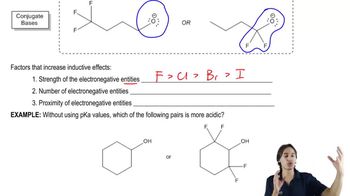
The 3 factors that determine the strength of inductive effects.

Stability of Conjugate Acids

The stability of a conjugate acid is influenced by factors such as electronegativity, resonance, and inductive effects. A more stable conjugate acid will have a lower tendency to donate a proton, thus correlating with a stronger base. Evaluating the stability of conjugate acids helps in predicting the direction of acid-base reactions and the relative strengths of the corresponding bases.
Video consigliato:
04:31
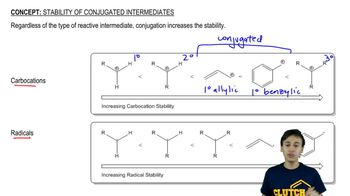
Stability of Conjugated Intermediates