Ch. 4 - Acids and Bases/Electron Flow
Mullins - Organic Chemistry: A Learner Centered Approach 1st Edition
Mullins1st EditionOrganic Chemistry: A Learner Centered ApproachISBN: 9780137566471Non è quello che usi tu?Cambia libro di testo
Capitolo 3, Problema 62b(i,ii)

For the following acid–base pairs,
(i) complete the reaction;
(ii) identify the acid (A), base (B), conjugate acid (CA), and conjugate base (CB);
(b) Chemical reaction showing H-Cl and O- with arrows indicating acid-base interaction.

Guida verificata passo dopo passo
1
Step 1: Write the general form of an acid-base reaction. In an acid-base reaction, the acid donates a proton (H⁺) to the base, forming its conjugate base and the conjugate acid of the base. Represent this as: Acid + Base → Conjugate Base + Conjugate Acid.
Step 2: Identify the acid and base in the given pair. Look at the chemical species provided in the problem and determine which one acts as the proton donor (acid) and which one acts as the proton acceptor (base).
Step 3: Complete the reaction by showing the transfer of a proton (H⁺) from the acid to the base. Use proper chemical notation to write the products: the conjugate base of the acid and the conjugate acid of the base.
Step 4: Label the species in the reaction. Assign the labels Acid (A), Base (B), Conjugate Acid (CA), and Conjugate Base (CB) to the appropriate chemical species based on their roles in the reaction.
Step 5: Verify the reaction follows the Bronsted-Lowry acid-base theory. Ensure that the acid loses a proton to form its conjugate base and the base gains a proton to form its conjugate acid. Double-check the chemical formulas and charges for accuracy.

Risposta video verificata per un problema simile:

Questa soluzione video è stata consigliata dai nostri tutor come utile per risolvere questo problema.
Durata del video:
2m

Concetti chiave

Ecco i concetti essenziali che devi comprendere per rispondere correttamente alla domanda.

Acid-Base Theory

Acid-base theory explains the behavior of acids and bases in chemical reactions. According to the Brønsted-Lowry theory, an acid is a proton donor, while a base is a proton acceptor. This framework helps in understanding how substances interact in acid-base reactions, allowing for the identification of reactants and products in a given reaction.
Video consigliato:
02:49
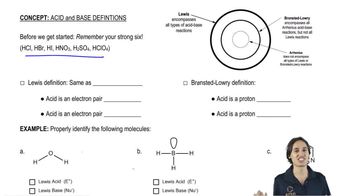
The Lewis definition of acids and bases.

Conjugate Acid-Base Pairs

Conjugate acid-base pairs consist of two species that differ by the presence of a proton (H+). When an acid donates a proton, it forms its conjugate base, while the base that accepts the proton becomes its conjugate acid. Recognizing these pairs is essential for analyzing acid-base reactions and predicting the direction of equilibrium.
Video consigliato:
Percorso guidato
2:56
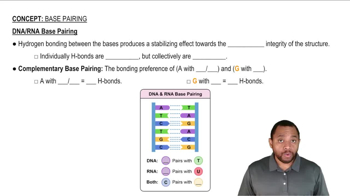
Base Pairing Concept 1

Reaction Completion

Completing an acid-base reaction involves writing the products formed when an acid reacts with a base. This includes identifying the resulting conjugate acid and conjugate base. Understanding the stoichiometry and the nature of the reactants is crucial for accurately representing the reaction and determining the equilibrium position.
Video consigliato:
05:53
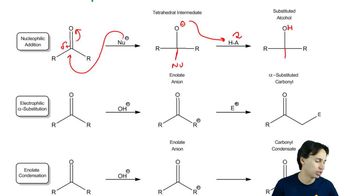
Condensation Reactions