Design an acid–base extraction scheme to separate a mixture of the basic amine N,N-dimethylaniline and naphthalene.
Ch. 4 - Acids and Bases/Electron Flow

Mullins1st EditionOrganic Chemistry: A Learner Centered ApproachISBN: 9780137566471Non è quello che usi tu?Cambia libro di testo
Capitolo 3, Problema 23c
Given the Keq values for the following acid–base reactions, identify the strongest acid and the strongest base.
(c) 
Guida verificata passo dopo passo1
Identify the acid and base in each reaction. Recall that acids donate protons (H⁺), and bases accept protons.
Use the provided equilibrium constant (K_eq) values to determine the direction of the reaction. A larger K_eq value indicates that the reaction strongly favors the products, meaning the acid on the reactant side is weaker than the conjugate acid on the product side.
Compare the acids in the reactions. The strongest acid will be the one that donates a proton most readily, which corresponds to the acid on the reactant side of the reaction with the smallest K_eq value.
Compare the bases in the reactions. The strongest base will be the one that accepts a proton most readily, which corresponds to the base on the reactant side of the reaction with the largest K_eq value.
Summarize your findings by identifying the strongest acid and the strongest base based on the trends in K_eq values and the acid–base pairs involved.

Risposta video verificata per un problema simile:
Questa soluzione video è stata consigliata dai nostri tutor come utile per risolvere questo problema.
Durata del video:
3mConcetti chiave
Ecco i concetti essenziali che devi comprendere per rispondere correttamente alla domanda.
Acid-Base Equilibrium
Acid-base equilibrium refers to the state where the rates of the forward and reverse reactions of an acid dissociating into its conjugate base and a proton are equal. The equilibrium constant (K_eq) quantifies this balance, with larger K_eq values indicating a stronger tendency for the acid to donate protons, thus identifying stronger acids and bases in a reaction.
Video consigliato:
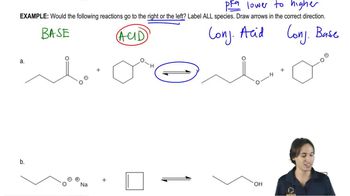
Determining Acid/Base Equilibrium
Strength of Acids and Bases
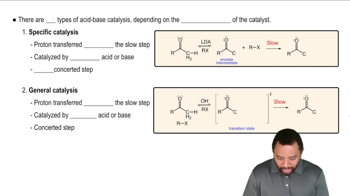
The strength of an acid or base is determined by its ability to donate protons (for acids) or accept protons (for bases). Strong acids completely dissociate in solution, while weak acids only partially dissociate. Similarly, strong bases fully accept protons, whereas weak bases do so only partially. The K_eq values help compare these strengths quantitatively.
Video consigliato:
Percorso guidato
Acid-Base Catalysis Concept 3
Conjugate Acid-Base Pairs
In acid-base reactions, acids and bases exist as conjugate pairs, where the acid donates a proton to become its conjugate base, and the base accepts a proton to become its conjugate acid. Understanding these pairs is crucial for determining the relative strength of acids and bases, as the strength of an acid is inversely related to the strength of its conjugate base.
Video consigliato:
Percorso guidato
Base Pairing Concept 1
Pratica correlata
Domanda del libro di testo
1353
views
Domanda del libro di testo
An unknown acid (HA) has been identified as very strong. What does this tell you about the stability of the conjugate base, A⁻? Is it strong or weak? Is it reactive or unreactive?
1100
views
Domanda del libro di testo
Given the Keq values for the following acid–base reactions, identify the strongest acid and the strongest base.
(a)
1113
views
Domanda del libro di testo
Given the value of Keq for the following acid–base reactions, identify the weakest acid and the weakest base.
(c)
1115
views
Domanda del libro di testo
An unknown base (B⁻) has been identified as very weak. What does this tell you about the strength of its conjugate acid, HB? Is it stable or unstable? Is it reactive or unreactive?
844
views
Domanda del libro di testo
Given the Keq values for the following acid–base reactions, identify the strongest acid and the strongest base.
(b)
1112
views