Ch. 4 - Acids and Bases/Electron Flow
Mullins - Organic Chemistry: A Learner Centered Approach 1st Edition
Mullins1st EditionOrganic Chemistry: A Learner Centered ApproachISBN: 9780137566471Non è quello che usi tu?Cambia libro di testo
Capitolo 3, Problema 52d

Identify the most acidic proton in each pair. Tell which structural features you analyzed and why you weighted them as you did in picking one answer. [Always start by drawing the conjugate base.]
(d)

Guida verificata passo dopo passo
1
Step 1: Begin by drawing the conjugate base for each molecule. For the benzyl proton (H attached to the CH2 group next to the benzene ring), remove the proton to form a benzyl carbanion. For the hydroxyl proton (OH group), remove the proton to form an alkoxide ion.
Step 2: Analyze the stability of the conjugate bases. The benzyl carbanion benefits from resonance stabilization because the negative charge can delocalize into the aromatic ring. This resonance effect significantly increases the stability of the benzyl carbanion.
Step 3: Compare this to the alkoxide ion formed from the hydroxyl group. The alkoxide ion does not have resonance stabilization, but it does have inductive effects from the surrounding alkyl groups. However, these effects are weaker compared to resonance stabilization.
Step 4: Consider the electronegativity of the atoms involved. Oxygen in the hydroxyl group is more electronegative than carbon in the benzyl group, which means the alkoxide ion can better stabilize the negative charge compared to a simple carbanion. However, resonance stabilization in the benzyl carbanion outweighs this factor.
Step 5: Conclude that the benzyl proton is more acidic because its conjugate base (benzyl carbanion) is more stable due to resonance effects. Structural features like resonance stabilization are weighted heavily in determining acidity.

Risposta video verificata per un problema simile:

Questa soluzione video è stata consigliata dai nostri tutor come utile per risolvere questo problema.

Concetti chiave

Ecco i concetti essenziali che devi comprendere per rispondere correttamente alla domanda.

Acidity and pKa

Acidity in organic chemistry refers to the tendency of a compound to donate a proton (H+). The strength of an acid is often measured by its pKa value; lower pKa values indicate stronger acids. Understanding the relationship between acidity and pKa is crucial for identifying the most acidic proton in a given structure.
Video consigliato:
07:45
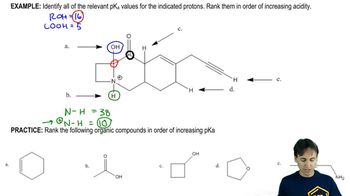
Identifying pKa values

Conjugate Base Stability

The stability of the conjugate base formed after deprotonation is a key factor in determining acidity. A more stable conjugate base corresponds to a stronger acid. Factors influencing stability include resonance, electronegativity of atoms, and inductive effects, which can help predict which proton is more acidic.
Video consigliato:
04:31
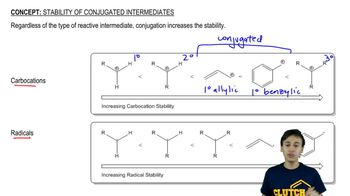
Stability of Conjugated Intermediates

Structural Features Influencing Acidity

Various structural features can affect the acidity of protons in organic molecules. These include the presence of electronegative atoms, resonance structures, and hybridization of the atom bearing the proton. Analyzing these features allows for a systematic approach to determine which proton is the most acidic in a pair.
Video consigliato:
Percorso guidato
1:05
Citric Acid Cycle Structures Concept 1