Ch. 4 - Acids and Bases/Electron Flow
Mullins - Organic Chemistry: A Learner Centered Approach 1st Edition
Mullins1st EditionOrganic Chemistry: A Learner Centered ApproachISBN: 9780137566471Non è quello che usi tu?Cambia libro di testo
Capitolo 3, Problema 64a

Identify the stronger acid in each pair. Explain your choice. Citing pKa values is not an acceptable answer.
(a) Structural formulas comparing the thiol group (SH) and hydroxyl group (OH) for acidity ranking.

Guida verificata passo dopo passo
1
Step 1: Understand the concept of acid strength. Acid strength is determined by the ability of an acid to donate a proton (H⁺). A stronger acid will more readily donate a proton compared to a weaker acid.
Step 2: Analyze the molecular structure of each acid in the pair. Look for factors that influence acid strength, such as electronegativity, resonance stabilization, inductive effects, and bond strength.
Step 3: Consider the electronegativity of the atom bonded to the acidic hydrogen. A more electronegative atom will stabilize the negative charge on the conjugate base, making the acid stronger.
Step 4: Evaluate resonance effects. If the conjugate base of an acid can delocalize its negative charge through resonance, the acid is stronger because the conjugate base is more stable.
Step 5: Examine inductive effects. Electronegative atoms or groups near the acidic hydrogen can pull electron density away, stabilizing the conjugate base and increasing acid strength.

Risposta video verificata per un problema simile:

Questa soluzione video è stata consigliata dai nostri tutor come utile per risolvere questo problema.
Durata del video:
3m

Concetti chiave

Ecco i concetti essenziali che devi comprendere per rispondere correttamente alla domanda.

Acid Strength

Acid strength refers to the ability of an acid to donate protons (H⁺ ions) in a solution. Stronger acids dissociate more completely in water, leading to a higher concentration of H⁺ ions. Factors influencing acid strength include the stability of the conjugate base, electronegativity of atoms, and the presence of electron-withdrawing or donating groups.
Video consigliato:
03:09
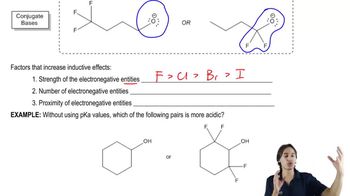
The 3 factors that determine the strength of inductive effects.

Conjugate Base Stability

The stability of a conjugate base is crucial in determining the strength of its corresponding acid. A more stable conjugate base indicates a stronger acid, as the equilibrium favors the dissociation of the acid. Factors affecting stability include resonance, electronegativity, and the size of the atom bearing the negative charge.
Video consigliato:
04:31
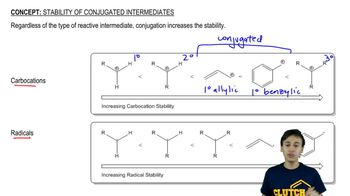
Stability of Conjugated Intermediates

Inductive Effect

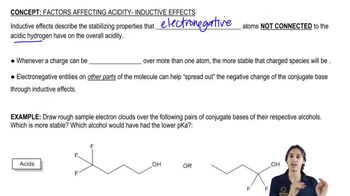
The inductive effect involves the transmission of charge through a chain of atoms in a molecule, which can influence acid strength. Electron-withdrawing groups (EWGs) stabilize the negative charge on the conjugate base, enhancing acid strength, while electron-donating groups (EDGs) can destabilize it, leading to weaker acids. Understanding this effect is essential for comparing acid strengths.
Video consigliato:
01:47
Understanding the Inductive Effect.