
Ch. 4 - Acids and Bases/Electron Flow
Mullins - Organic Chemistry: A Learner Centered Approach 1st Edition
Mullins1st EditionOrganic Chemistry: A Learner Centered ApproachISBN: 9780137566471Non è quello che usi tu?Cambia libro di testo
Capitolo 3, Problema 79c

In addition to radicals, anions, and cations, a fourth class of reactive intermediates is carbenes. A neutral species, the simplest carbene has a molecular formula of CH2.
(c) Carbenes are Lewis acids. Based on your answers to (a) and (b), explain this observation.

Guida verificata passo dopo passo
1
Carbenes are neutral species with the general formula R₂C: (or CH₂ in the simplest case). They have a divalent carbon atom with only six valence electrons, making them electron-deficient.
To understand why carbenes act as Lewis acids, recall the definition of a Lewis acid: a species that can accept a pair of electrons.
In the case of carbenes, the carbon atom has an empty p orbital due to its electron deficiency. This empty orbital can accept a pair of electrons from a Lewis base, fulfilling the criteria for a Lewis acid.
The electron-deficient nature of carbenes arises from their electronic configuration, where the carbon atom has two nonbonding electrons (a lone pair) and two covalent bonds, leaving the p orbital vacant.
Thus, the ability of carbenes to accept electron pairs into their empty p orbital explains why they are classified as Lewis acids.

Risposta video verificata per un problema simile:

Questa soluzione video è stata consigliata dai nostri tutor come utile per risolvere questo problema.
Durata del video:
2m

Concetti chiave

Ecco i concetti essenziali che devi comprendere per rispondere correttamente alla domanda.

Carbenes

Carbenes are neutral reactive intermediates that contain a carbon atom with only six valence electrons, making them electron-deficient. The simplest carbene, methylene (CH₂), has two unshared electrons and can act as a nucleophile or electrophile in chemical reactions. Their unique structure allows them to participate in various organic reactions, often leading to the formation of new bonds.
Video consigliato:
01:48
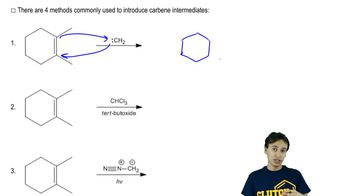
Reaction with a simple carbene.

Lewis Acids and Bases

Lewis acids are defined as species that can accept an electron pair, while Lewis bases donate an electron pair. Carbenes, due to their electron-deficient nature, can accept electron pairs from Lewis bases, thus behaving as Lewis acids. This property is crucial in understanding their reactivity and interactions with other chemical species.
Video consigliato:
02:49
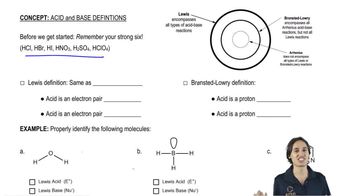
The Lewis definition of acids and bases.

Reactive Intermediates

Reactive intermediates are transient species that form during the course of a chemical reaction and are typically unstable. They include carbenes, radicals, anions, and cations, each playing a significant role in reaction mechanisms. Understanding these intermediates is essential for predicting the outcomes of chemical reactions and the pathways they may follow.
Video consigliato:
02:47
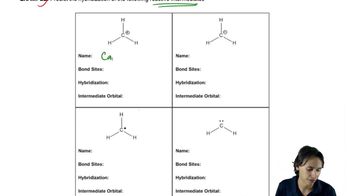
Introduction to the reactive intermediates.