Ch. 4 - Acids and Bases/Electron Flow
Mullins - Organic Chemistry: A Learner Centered Approach 1st Edition
Mullins1st EditionOrganic Chemistry: A Learner Centered ApproachISBN: 9780137566471Non è quello che usi tu?Cambia libro di testo
Capitolo 3, Problema 9d

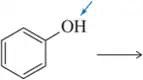
What is the conjugate base of each of the following acids? [The most acidic proton is indicated.]
(d) Chemical structure of a phenol with an arrow indicating the most acidic proton at the hydroxyl group (OH).

Guida verificata passo dopo passo
1
Identify the acidic proton in the molecule. In this case, the blue arrow points to the hydrogen atom attached to the oxygen in the hydroxyl (-OH) group.
Recall that the conjugate base is formed by removing the most acidic proton from the molecule. This involves deprotonation of the hydroxyl group.
Write the chemical equation for the deprotonation process: \( \text{R-OH} \rightarrow \text{R-O}^- + \text{H}^+ \), where \( \text{R} \) represents the cyclohexyl group.
Recognize that the conjugate base of the acid is the cyclohexoxide ion (\( \text{R-O}^- \)), which is the cyclohexyl group bonded to an oxygen atom carrying a negative charge.
Ensure that the negative charge on the oxygen is properly represented, as it results from the loss of the proton during deprotonation.

Risposta video verificata per un problema simile:

Questa soluzione video è stata consigliata dai nostri tutor come utile per risolvere questo problema.
Durata del video:
3m

Concetti chiave

Ecco i concetti essenziali che devi comprendere per rispondere correttamente alla domanda.

Acid-Base Chemistry

Acid-base chemistry involves the transfer of protons (H+) between species. An acid is defined as a proton donor, while a base is a proton acceptor. Understanding this concept is crucial for identifying conjugate acid-base pairs, where the conjugate base is formed when an acid donates a proton.
Video consigliato:
02:49
The Lewis definition of acids and bases.

Conjugate Base

The conjugate base of an acid is what remains after the acid has donated a proton. For example, when phenol (C6H5OH) donates its acidic proton from the hydroxyl group, it forms the phenoxide ion (C6H5O-), which is its conjugate base. Recognizing the structure of the conjugate base is essential for predicting its reactivity and properties.
Video consigliato:
03:27
Conjugated states

Resonance Stabilization

Resonance stabilization refers to the delocalization of electrons across multiple atoms in a molecule, which can enhance stability. In the case of phenoxide ion, the negative charge on the oxygen can be delocalized into the aromatic ring, making the conjugate base more stable than if the charge were localized. This concept is important for understanding the acidity of phenols compared to other alcohols.
Video consigliato:
03:43
The radical stability trend.