Ch. 4 - Acids and Bases/Electron Flow
Mullins - Organic Chemistry: A Learner Centered Approach 1st Edition
Mullins1st EditionOrganic Chemistry: A Learner Centered ApproachISBN: 9780137566471Non è quello che usi tu?Cambia libro di testo
Capitolo 3, Problema 2

Which is more stable, free hydrogen atoms or the diatomic H2 molecule? Why do you know this to be true?

Guida verificata passo dopo passo
1
Understand the question: The problem is asking about the relative stability of free hydrogen atoms (H) versus the diatomic hydrogen molecule (H₂). Stability in this context is related to energy—lower energy corresponds to greater stability.
Recall the concept of bond formation: When two hydrogen atoms combine to form an H₂ molecule, they form a covalent bond by sharing their electrons. Bond formation releases energy, which means the system moves to a lower energy state.
Apply the principle of energy minimization: The H₂ molecule is more stable than free hydrogen atoms because the energy released during bond formation makes the molecule lower in energy compared to the separate atoms.
Consider experimental evidence: The bond dissociation energy of H₂ (the energy required to break the H-H bond) is a positive value, indicating that energy must be supplied to break the bond and separate the molecule into free hydrogen atoms. This further supports that H₂ is more stable.
Conclude based on thermodynamics: The diatomic H₂ molecule is more stable than free hydrogen atoms because the formation of the H-H bond lowers the system's energy, and systems naturally favor lower-energy, more stable configurations.

Risposta video verificata per un problema simile:

Questa soluzione video è stata consigliata dai nostri tutor come utile per risolvere questo problema.
Durata del video:
4m

Concetti chiave

Ecco i concetti essenziali che devi comprendere per rispondere correttamente alla domanda.

Bond Formation and Stability

The stability of a molecule is often determined by the presence of chemical bonds. In the case of diatomic hydrogen (H₂), two hydrogen atoms share a pair of electrons, forming a covalent bond. This bond lowers the energy of the system compared to free hydrogen atoms, which exist as individual, unbonded entities. Thus, the formation of H₂ results in a more stable configuration.
Video consigliato:
03:43
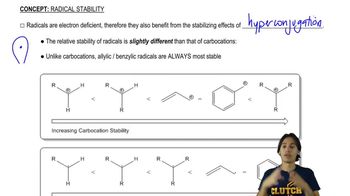
The radical stability trend.

Energy Considerations

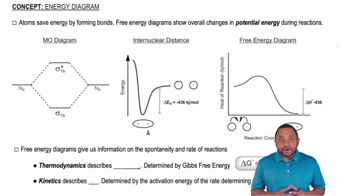
Chemical stability is closely related to energy levels. Free hydrogen atoms have higher potential energy due to their unbonded state. When they form H₂, energy is released, indicating that the H₂ molecule is at a lower energy state. This release of energy during bond formation is a key factor in determining the stability of molecules.
Video consigliato:
08:30
Introduction to free energy diagrams.

Thermodynamics and Reaction Favorability

Thermodynamics helps explain why certain reactions occur spontaneously. The formation of H₂ from free hydrogen atoms is favored because it leads to a decrease in Gibbs free energy, making the process thermodynamically favorable. This principle underlines the preference for stable molecular forms over individual atoms in chemical systems.
Video consigliato:
08:51
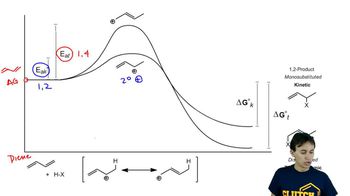
Kinetic vs. Thermodynamic Control