Ch. 5 - Chemical Reaction Analysis: Thermodynamics and Kinetics
Mullins - Organic Chemistry: A Learner Centered Approach 1st Edition
Mullins1st EditionOrganic Chemistry: A Learner Centered ApproachISBN: 9780137566471Non è quello che usi tu?Cambia libro di testo
Capitolo 4, Problema 15d

Calculate ∆H° for the following equilibrium processes.
(d)

Guida verificata passo dopo passo
1
Step 1: Identify the two conformations of the molecule in the equilibrium process. In this case, the molecule is methylcyclohexane, and the equilibrium involves the axial and equatorial positions of the methyl group on the cyclohexane ring.
Step 2: Recall that the ∆H° for this equilibrium process is related to the energy difference between the axial and equatorial conformations. The equatorial position is generally more stable due to reduced steric hindrance.
Step 3: Use the standard value for the energy difference between axial and equatorial positions of a methyl group on cyclohexane. This value is typically around -7.6 kJ/mol, favoring the equatorial conformation.
Step 4: Write the expression for ∆H° for the equilibrium process. Since the equatorial conformation is more stable, the ∆H° will be negative, indicating that the equilibrium favors the equatorial conformation.
Step 5: Confirm the direction of equilibrium and the sign of ∆H° based on the stability of the conformations. The equatorial conformation is lower in energy, so the equilibrium constant will favor this conformation, and ∆H° will reflect this preference.

Risposta video verificata per un problema simile:

Questa soluzione video è stata consigliata dai nostri tutor come utile per risolvere questo problema.

Concetti chiave

Ecco i concetti essenziali che devi comprendere per rispondere correttamente alla domanda.

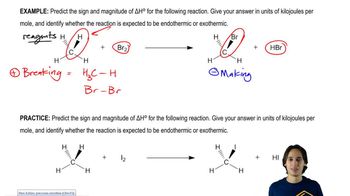
Enthalpy Change (∆H°)

Enthalpy change (∆H°) is a measure of the heat content of a system at constant pressure. It indicates whether a reaction is exothermic (releases heat, ∆H° < 0) or endothermic (absorbs heat, ∆H° > 0). Understanding how to calculate ∆H° is crucial for analyzing chemical reactions and their energy profiles.
Video consigliato:
04:38
Calculating Enthalpies

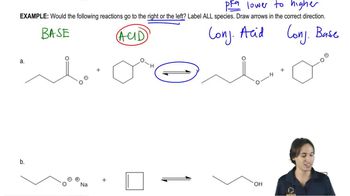
Equilibrium Processes

Equilibrium processes refer to the state in which the rates of the forward and reverse reactions are equal, resulting in constant concentrations of reactants and products. The equilibrium constant (K) can be used to relate the concentrations of species at equilibrium, and changes in enthalpy can affect the position of equilibrium according to Le Chatelier's principle.
Video consigliato:
04:00
Determining Acid/Base Equilibrium

Hess's Law

Hess's Law states that the total enthalpy change for a reaction is the sum of the enthalpy changes for individual steps, regardless of the pathway taken. This principle allows for the calculation of ∆H° for complex reactions by breaking them down into simpler steps, making it essential for solving problems involving enthalpy changes in equilibrium processes.
Video consigliato:
Percorso guidato
1:39
The Beer-Lambert Law Concept 2