Ch. 5 - Chemical Reaction Analysis: Thermodynamics and Kinetics
Mullins - Organic Chemistry: A Learner Centered Approach 1st Edition
Mullins1st EditionOrganic Chemistry: A Learner Centered ApproachISBN: 9780137566471Non è quello che usi tu?Cambia libro di testo
Capitolo 4, Problema 24e

For the following acid–base reaction, (e) calculate ∆G° at 273 K.

Guida verificata passo dopo passo
1
Step 1: Identify the acid and base in the reaction. Determine the conjugate acid and conjugate base formed after the reaction. This will help in understanding the equilibrium of the reaction.
Step 2: Use the pKa values of the acid and conjugate acid to calculate the equilibrium constant (K). The relationship between pKa and K is given by \( K = 10^{\Delta pKa} \), where \( \Delta pKa = pKa_{acid} - pKa_{conjugate\ acid} \).
Step 3: Recall the relationship between the Gibbs free energy change (\( \Delta G^\circ \)) and the equilibrium constant (K). The formula is \( \Delta G^\circ = -RT \ln K \), where \( R \) is the gas constant (8.314 J/mol·K) and \( T \) is the temperature in Kelvin.
Step 4: Substitute the values for \( R \), \( T \), and \( K \) into the formula \( \Delta G^\circ = -RT \ln K \). Ensure that the temperature is given as 273 K and calculate \( \ln K \) using the equilibrium constant derived from \( \Delta pKa \).
Step 5: Perform the calculation to determine \( \Delta G^\circ \). Ensure units are consistent throughout the calculation (e.g., J/mol or kJ/mol). This will yield the Gibbs free energy change for the reaction at 273 K.

Risposta video verificata per un problema simile:

Questa soluzione video è stata consigliata dai nostri tutor come utile per risolvere questo problema.
Durata del video:
4m

Concetti chiave

Ecco i concetti essenziali che devi comprendere per rispondere correttamente alla domanda.

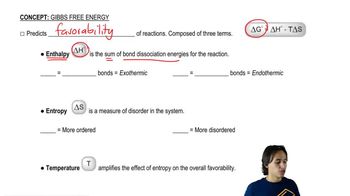
Gibbs Free Energy (∆G°)

Gibbs Free Energy (∆G°) is a thermodynamic potential that measures the maximum reversible work obtainable from a thermodynamic system at constant temperature and pressure. It is a crucial concept in predicting the spontaneity of a reaction; a negative ∆G° indicates that a reaction can occur spontaneously, while a positive value suggests non-spontaneity.
Video consigliato:
05:02
Breaking down the different terms of the Gibbs Free Energy equation.

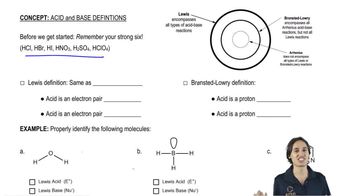
Acid-Base Reactions

Acid-base reactions involve the transfer of protons (H⁺ ions) between reactants. In these reactions, acids donate protons, while bases accept them. Understanding the strength of acids and bases, as well as their dissociation constants (Ka and Kb), is essential for calculating the equilibrium position and the Gibbs Free Energy change associated with the reaction.
Video consigliato:
02:49
The Lewis definition of acids and bases.

Temperature and Reaction Quotient

Temperature plays a significant role in determining the Gibbs Free Energy of a reaction. The reaction quotient (Q) reflects the ratio of the concentrations of products to reactants at any point in time. At equilibrium, the relationship between Gibbs Free Energy, temperature, and the reaction quotient can be expressed using the equation ∆G° = ∆H° - T∆S°, where ∆H° is the change in enthalpy and ∆S° is the change in entropy.
Video consigliato:
Percorso guidato
3:22
EAS Reactions of Pyridine Concept 3