Ch. 5 - Chemical Reaction Analysis: Thermodynamics and Kinetics
Mullins - Organic Chemistry: A Learner Centered Approach 1st Edition
Mullins1st EditionOrganic Chemistry: A Learner Centered ApproachISBN: 9780137566471Non è quello che usi tu?Cambia libro di testo
Capitolo 4, Problema 7a

For the following equilibrium processes and the corresponding ∆G°, indicate whether you expect the equilibrium constant to be greater than, equal to, or less than 1. Justify your expectation in words.
(a) Chemical reaction diagram showing two structures with ΔG° = -1.8 kcal/mol, indicating a spontaneous process.

Guida verificata passo dopo passo
1
Understand the relationship between the Gibbs free energy change (∆G°) and the equilibrium constant (K) using the equation: ∆G° = -RT ln(K), where R is the gas constant and T is the temperature in Kelvin.
Analyze the sign of ∆G°: If ∆G° is negative, the reaction is spontaneous in the forward direction, and K will be greater than 1. If ∆G° is positive, the reaction is non-spontaneous in the forward direction, and K will be less than 1. If ∆G° is zero, the system is at equilibrium, and K will equal 1.
For each equilibrium process provided, determine the sign of ∆G° (positive, negative, or zero) based on the given value or description.
Use the relationship between ∆G° and K to predict whether the equilibrium constant is greater than, equal to, or less than 1 for each process.
Justify your prediction in words by explaining how the sign of ∆G° influences the equilibrium constant, referencing the thermodynamic principles outlined in step 2.

Risposta video verificata per un problema simile:

Questa soluzione video è stata consigliata dai nostri tutor come utile per risolvere questo problema.
Durata del video:
2m

Concetti chiave

Ecco i concetti essenziali che devi comprendere per rispondere correttamente alla domanda.

Gibbs Free Energy (∆G°)

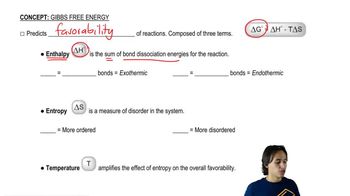
Gibbs Free Energy (∆G°) is a thermodynamic potential that measures the maximum reversible work obtainable from a thermodynamic system at constant temperature and pressure. A negative ∆G° indicates that a reaction is spontaneous and favors the formation of products, while a positive ∆G° suggests that the reaction is non-spontaneous and favors the reactants.
Video consigliato:
05:02
Breaking down the different terms of the Gibbs Free Energy equation.

Equilibrium Constant (K)

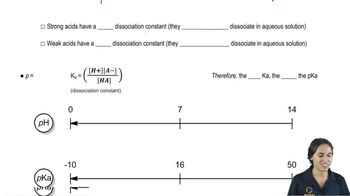
The equilibrium constant (K) is a dimensionless value that expresses the ratio of the concentrations of products to reactants at equilibrium for a given reaction at a specific temperature. If K > 1, products are favored at equilibrium; if K < 1, reactants are favored. The relationship between K and ∆G° is given by the equation ∆G° = -RT ln(K), where R is the gas constant and T is the temperature in Kelvin.
Video consigliato:
02:19
The relationship between equilibrium constant and pKa.

Relationship between ∆G° and K

The relationship between Gibbs Free Energy (∆G°) and the equilibrium constant (K) is crucial for predicting the direction of a reaction. If ∆G° is negative, K will be greater than 1, indicating a product-favored reaction. Conversely, if ∆G° is positive, K will be less than 1, indicating a reactant-favored reaction. This relationship allows chemists to assess the favorability of reactions based on thermodynamic data.
Video consigliato:
01:40
Same atoms, same connectivity, 1 chiral center.