Ch. 5 - Chemical Reaction Analysis: Thermodynamics and Kinetics
Mullins - Organic Chemistry: A Learner Centered Approach 1st Edition
Mullins1st EditionOrganic Chemistry: A Learner Centered ApproachISBN: 9780137566471Non è quello che usi tu?Cambia libro di testo
Capitolo 4, Problema 59b

Reactions (a) and (b) are disfavored overall (∆G° > 0), yet they are favored based on ∆H°. Identify the bonds formed and broken for (a) and (b).
(b)

Guida verificata passo dopo passo
1
Step 1: Analyze the reaction provided. The reactants are propanal (CH3CH2CHO) and methanol (CH3OH), and the product is a hemiacetal (CH3CH(OH)OCH3). This reaction involves the formation of a hemiacetal from an aldehyde and an alcohol.
Step 2: Identify the bonds broken in the reaction. In the aldehyde (CH3CH2CHO), the C=O double bond is partially broken as the oxygen forms a new bond with the hydrogen from the alcohol. In methanol (CH3OH), the O-H bond is broken as the oxygen forms a new bond with the carbon of the aldehyde.
Step 3: Identify the bonds formed in the reaction. A new C-O bond is formed between the carbon of the aldehyde and the oxygen of the alcohol. Additionally, a new O-H bond is formed on the oxygen of the aldehyde, converting it into a hydroxyl group.
Step 4: Explain why the reaction is favored based on enthalpy (∆H°). The formation of strong bonds, such as the C-O bond in the hemiacetal and the O-H bond, releases energy, making the reaction exothermic and favorable in terms of enthalpy.
Step 5: Discuss why the reaction is disfavored overall (∆G° > 0). Despite the favorable enthalpy change, the reaction may be disfavored due to entropy considerations. The formation of a more ordered product (hemiacetal) from two reactants leads to a decrease in entropy, which can make the Gibbs free energy positive and the reaction disfavored overall.

Risposta video verificata per un problema simile:

Questa soluzione video è stata consigliata dai nostri tutor come utile per risolvere questo problema.

Concetti chiave

Ecco i concetti essenziali che devi comprendere per rispondere correttamente alla domanda.

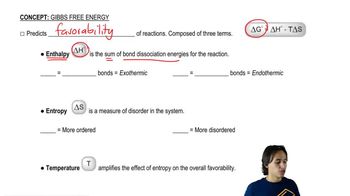
Gibbs Free Energy (∆G)

Gibbs Free Energy (∆G) is a thermodynamic potential that measures the maximum reversible work obtainable from a thermodynamic system at constant temperature and pressure. A positive ∆G indicates that a reaction is non-spontaneous under standard conditions, meaning it requires energy input to proceed. Understanding ∆G is crucial for analyzing the favorability of chemical reactions, particularly in the context of reactions that may be driven by enthalpy changes.
Video consigliato:
05:02
Breaking down the different terms of the Gibbs Free Energy equation.

Enthalpy (∆H)

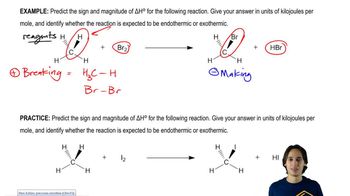
Enthalpy (∆H) is a measure of the total heat content of a system and reflects the energy associated with the bonds formed and broken during a chemical reaction. A negative ∆H indicates that a reaction releases heat (exothermic), which can favor the reaction despite a positive ∆G. Recognizing the role of enthalpy helps in understanding why certain reactions may be thermodynamically disfavored overall yet still proceed due to favorable bond formation.
Video consigliato:
04:38
Calculating Enthalpies

Bond Formation and Breaking

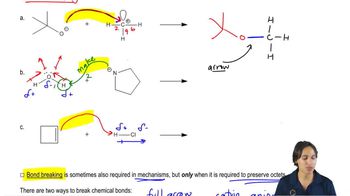
In chemical reactions, bonds between atoms are broken in the reactants and new bonds are formed in the products. The types of bonds involved (e.g., covalent, ionic) and their strengths significantly influence the overall energy change of the reaction. Identifying which bonds are formed and broken is essential for understanding the reaction mechanism and the associated changes in enthalpy and Gibbs free energy, particularly in reactions that are thermodynamically unfavorable.
Video consigliato:
02:31
Identifying Bond Breaking