Ch. 5 - Chemical Reaction Analysis: Thermodynamics and Kinetics
Mullins - Organic Chemistry: A Learner Centered Approach 1st Edition
Mullins1st EditionOrganic Chemistry: A Learner Centered ApproachISBN: 9780137566471Non è quello che usi tu?Cambia libro di testo
Capitolo 4, Problema 41b

The following are all substitution reactions, two of which we study in later chapters. With no knowledge of mechanism, what would you expect the ratio of products to be for each reaction, based on a random statistical distribution?
(b) Replacing a hydrogen (H) with bromine (Br):
6

Guida verificata passo dopo passo
1
Step 1: Identify the type of reaction. This is a substitution reaction where a hydrogen atom on the benzene ring is replaced by bromine (Br). The reaction is expected to follow a random statistical distribution since no specific mechanism is provided.
Step 2: Analyze the structure of the molecule. The benzene ring has three distinct positions for substitution: ortho (adjacent to the methyl group), meta (one position away from the methyl group), and para (opposite to the methyl group). These positions are labeled as A, B, and C in the image.
Step 3: Count the number of hydrogens available for substitution at each position. The ortho positions (A) have two hydrogens, the meta positions (B) have two hydrogens, and the para position (C) has one hydrogen.
Step 4: Calculate the statistical ratio of products based on the number of hydrogens available for substitution. Since there are 2 hydrogens at ortho, 2 at meta, and 1 at para, the ratio of products will be proportional to these numbers: 2:2:1.
Step 5: Conclude that the expected ratio of products (A:B:C) based on random statistical distribution is 2:2:1, assuming no preference for any specific position due to electronic or steric effects.

Risposta video verificata per un problema simile:

Questa soluzione video è stata consigliata dai nostri tutor come utile per risolvere questo problema.
Durata del video:
1m

Concetti chiave

Ecco i concetti essenziali che devi comprendere per rispondere correttamente alla domanda.

Substitution Reactions

Substitution reactions involve the replacement of one atom or group in a molecule with another atom or group. In organic chemistry, these reactions are common in aromatic compounds, where a hydrogen atom can be replaced by a halogen, such as bromine or chlorine. Understanding the nature of these reactions is crucial for predicting product ratios based on the stability and reactivity of the intermediates formed.
Video consigliato:
01:34
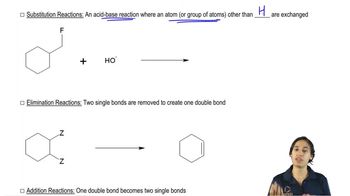
Recognizing Substitution Reactions.

Statistical Distribution of Products

In the context of substitution reactions, statistical distribution refers to the likelihood of forming different products based on the number of available reactive sites and the symmetry of the molecule. For example, if a molecule has multiple equivalent positions for substitution, the products will form in a ratio that reflects the number of ways each product can be generated, assuming no preference for any specific site.
Video consigliato:
11:07
Bridged-Products

Mechanism of Bromination

The mechanism of bromination in aromatic compounds typically involves the formation of a bromonium ion intermediate, which can lead to different substitution products depending on the orientation of the substituents already present on the aromatic ring. Understanding this mechanism helps predict the distribution of products, as certain positions may be more favorable for substitution due to electronic effects or steric hindrance.
Video consigliato:
00:54
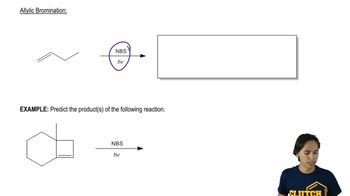
Mechanism of Allylic Bromination.
Pratica correlata
Domanda del libro di testo

The radical fluorination of 2-methyl propane resulted in a 14:86 ratio of products.

(a) On the basis of this ratio, calculate the relative reactivity of 1° and 3° C―H bonds in the radical fluorination.

1167
views

Domanda del libro di testo

For each pair of reactions, predict which will happen more quickly. [For (c) and (d), the more substituted carbocation is more stable due to hyperconjugation.]

(c)

874
views
Domanda del libro di testo

Through the course of this chapter, we have discussed only alkane chlorination and bromination, yet there are two other halogens we have not discussed.

(b) Is radical iodination a favorable reaction? Do you expect it to be selective? Show your calculations.

957
views
Domanda del libro di testo

Given the ratio of products obtained in the bromination of propane, calculate the relative reactivity of a 1° C–H bond to a 2° C–H bond under these conditions.

1322
views
Domanda del libro di testo

The following are all substitution reactions, two of which we study in later chapters. With no knowledge of mechanism, what would you expect the ratio of products to be for each reaction, based on a random statistical distribution?

(a) Replacing a hydrogen (H) with deuterium (D):

693
views
Domanda del libro di testo

The following are all substitution reactions, two of which we study in later chapters. With no knowledge of mechanism, what would you expect the ratio of products to be for each reaction, based on a random statistical distribution?

(a) Replacing a hydrogen (H) with chlorine (Cl):

874
views