Ch. 5 - Chemical Reaction Analysis: Thermodynamics and Kinetics
Mullins - Organic Chemistry: A Learner Centered Approach 1st Edition
Mullins1st EditionOrganic Chemistry: A Learner Centered ApproachISBN: 9780137566471Non è quello che usi tu?Cambia libro di testo
Capitolo 4, Problema 71

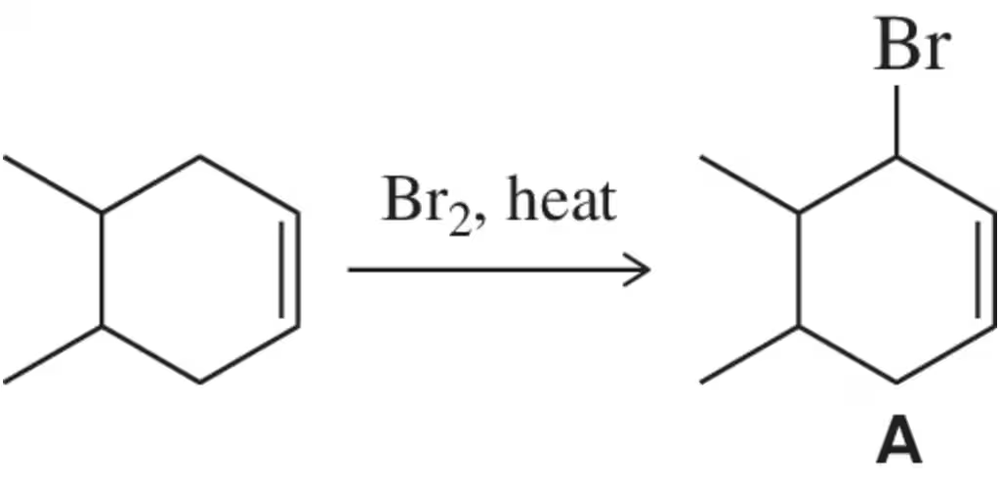
The halogenation of an alkane when there is an alkene present in the molecule does not proceed with the regioselectivity you might expect. Using principles similar to those developed in this chapter, rationalize the formation of A as the only product. We study this reaction further in Chapter 8.
Chemical reaction diagram showing bromination of an alkene, producing compound A with Br2 and heat.

Guida verificata passo dopo passo
1
Identify the functional groups present in the molecule: The molecule contains both an alkane and an alkene. Alkanes undergo free radical halogenation, while alkenes typically undergo electrophilic addition reactions. Recognizing these functional groups is key to understanding the reaction pathway.
Analyze the reactivity of the alkene: Alkenes are more reactive than alkanes due to the presence of a π-bond, which is electron-rich and can interact with electrophiles. However, in this case, the halogenation reaction is selective, and the alkene does not react as expected.
Consider the reaction conditions: Halogenation of alkanes typically occurs via a free radical mechanism, which involves initiation, propagation, and termination steps. The presence of light or heat is often required to generate radicals. The regioselectivity of the reaction is influenced by the stability of the intermediate radicals formed.
Rationalize the formation of product A: The regioselectivity of the reaction can be explained by the stability of the radical intermediate. When the halogen radical abstracts a hydrogen atom, it preferentially forms the most stable radical. In this case, the radical formed adjacent to the alkene is stabilized by resonance with the π-bond of the alkene, making it the favored intermediate.
Conclude why A is the only product: The formation of the stabilized radical intermediate leads to the selective halogenation at the position adjacent to the alkene. This regioselectivity is a result of the interplay between radical stability and the electronic effects of the alkene. The alkene itself does not react under these conditions because the reaction mechanism is specific to free radical halogenation of the alkane portion of the molecule.

Risposta video verificata per un problema simile:

Questa soluzione video è stata consigliata dai nostri tutor come utile per risolvere questo problema.
Durata del video:
4m

Concetti chiave

Ecco i concetti essenziali che devi comprendere per rispondere correttamente alla domanda.

Regioselectivity

Regioselectivity refers to the preference of a chemical reaction to yield one structural isomer over others when multiple possibilities exist. In the context of halogenation of alkanes and alkenes, regioselectivity is influenced by the stability of intermediates formed during the reaction, such as carbocations. Understanding how these intermediates stabilize can help predict which product will be favored.
Video consigliato:
05:09
Heck Reaction

Halogenation Mechanism

Halogenation is a reaction where halogens (like Cl or Br) are added to alkanes or alkenes. The mechanism typically involves the formation of a radical or carbocation intermediate, depending on whether the substrate is an alkane or alkene. The presence of an alkene can alter the pathway and stability of these intermediates, affecting the final product distribution.
Video consigliato:
03:45
Halogenation Mechanism

Stability of Intermediates

The stability of reaction intermediates, such as carbocations or radicals, plays a crucial role in determining the outcome of organic reactions. More stable intermediates are formed preferentially, leading to specific products. In the case of halogenation in the presence of alkenes, the stability of the formed intermediates can explain why one product is favored over others, as seen in the formation of product A.
Video consigliato:
04:31
Stability of Conjugated Intermediates