Ch. 5 - Chemical Reaction Analysis: Thermodynamics and Kinetics
Mullins - Organic Chemistry: A Learner Centered Approach 1st Edition
Mullins1st EditionOrganic Chemistry: A Learner Centered ApproachISBN: 9780137566471Non è quello che usi tu?Cambia libro di testo
Capitolo 4, Problema 4b

Which is the most acidic compound in each pair?
(b) HF vs. HCl

Guida verificata passo dopo passo
1
Step 1: Understand the concept of acidity. Acidity is determined by the ability of a compound to donate a proton (H⁺). The strength of an acid is influenced by factors such as bond strength and the stability of the conjugate base formed after donating a proton.
Step 2: Compare the bond strength of HF and HCl. The bond strength between hydrogen and fluorine (H-F) is stronger than the bond strength between hydrogen and chlorine (H-Cl). This is because fluorine is smaller and forms a shorter, stronger bond with hydrogen.
Step 3: Analyze the stability of the conjugate base. After donating a proton, HF forms F⁻ and HCl forms Cl⁻. Chloride ion (Cl⁻) is larger and can better distribute the negative charge compared to fluoride ion (F⁻), making Cl⁻ more stable.
Step 4: Relate bond strength and conjugate base stability to acidity. A weaker bond to hydrogen makes it easier for the compound to donate a proton, and a more stable conjugate base increases the likelihood of proton donation. These factors together determine the relative acidity of HF and HCl.
Step 5: Conclude based on the analysis. Since HCl has a weaker H-Cl bond and forms a more stable conjugate base (Cl⁻), it is more acidic than HF.

Risposta video verificata per un problema simile:

Questa soluzione video è stata consigliata dai nostri tutor come utile per risolvere questo problema.
Durata del video:
2m

Concetti chiave

Ecco i concetti essenziali che devi comprendere per rispondere correttamente alla domanda.

Acidity and pKa

Acidity refers to the ability of a compound to donate protons (H+ ions) in a solution. The strength of an acid is often measured using the pKa value, where a lower pKa indicates a stronger acid. Understanding the pKa values of different acids helps in comparing their acidity and predicting their behavior in chemical reactions.
Video consigliato:
07:45
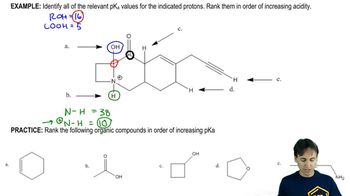
Identifying pKa values

Bond Strength and Electronegativity

The strength of the bond between hydrogen and the other atom in an acid influences its acidity. In binary acids like HF and HCl, the bond strength decreases down the group in the periodic table. Additionally, electronegativity plays a role; as the electronegativity of the atom bonded to hydrogen increases, the bond becomes more polarized, facilitating proton donation.
Video consigliato:
1:47
Electronegativity

Comparative Acidity of Hydrohalic Acids

Hydrohalic acids (HF, HCl, HBr, HI) exhibit varying acidity based on the halogen involved. HCl is generally more acidic than HF due to the weaker H-Cl bond compared to the H-F bond, which is stronger and less likely to release a proton. This comparative analysis is essential for determining which compound is more acidic in pairs of hydrohalic acids.
Video consigliato:
02:41
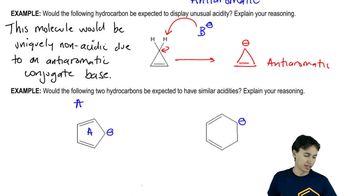
Comparing hydrocarbon acidity