Ch. 6 - Stereoisomerism: Arrangement of Atoms in Space
Mullins - Organic Chemistry: A Learner Centered Approach 1st Edition
Mullins1st EditionOrganic Chemistry: A Learner Centered ApproachISBN: 9780137566471Non è quello che usi tu?Cambia libro di testo
Capitolo 5, Problema 2c

Convert the following structural formulas to line-angle drawings
(c) CH3CH2NHCH2CH2OH

Guida verificata passo dopo passo
1
Step 1: Understand the structural formula provided. The molecule CH₃CH₂NHCH₂CH₂OH consists of an ethyl group (CH₃CH₂-) attached to an amine group (-NH-), which is further connected to a two-carbon chain (-CH₂CH₂-) ending in a hydroxyl group (-OH).
Step 2: Recall the conventions of line-angle drawings. In these representations, carbon atoms are implied at the vertices and ends of lines, hydrogen atoms bonded to carbon are omitted, and heteroatoms like nitrogen (N) and oxygen (O) are explicitly shown.
Step 3: Begin by drawing the ethyl group as a two-line segment, where the first vertex represents the CH₃ group and the second vertex represents the CH₂ group. Connect this to the nitrogen atom (N), which should be explicitly labeled.
Step 4: From the nitrogen atom, draw a single line to represent the CH₂ group, followed by another line to represent the second CH₂ group. Ensure the nitrogen atom has a single bond to the ethyl group and another single bond to the first CH₂ group.
Step 5: At the end of the second CH₂ group, add the hydroxyl group (-OH) explicitly. The oxygen atom (O) should be labeled, and a single bond should connect it to the terminal CH₂ group. Verify that the drawing adheres to the correct connectivity and bonding pattern.

Risposta video verificata per un problema simile:

Questa soluzione video è stata consigliata dai nostri tutor come utile per risolvere questo problema.
Durata del video:
3m

Concetti chiave

Ecco i concetti essenziali che devi comprendere per rispondere correttamente alla domanda.

Line-Angle Drawings

Line-angle drawings, also known as skeletal structures, are a simplified way of representing organic molecules. In these drawings, carbon atoms are represented by the ends and intersections of lines, while hydrogen atoms are typically omitted for clarity. Functional groups, such as -NH and -OH, are explicitly shown to convey important chemical information. This method allows chemists to visualize complex structures quickly and efficiently.
Video consigliato:
02:46
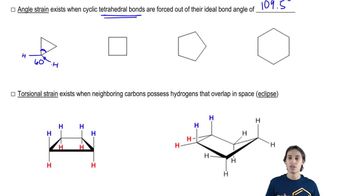
What is angle strain?

Functional Groups

Functional groups are specific groups of atoms within molecules that are responsible for the characteristic chemical reactions of those molecules. In the given formula, -NH (amine) and -OH (alcohol) are functional groups that influence the molecule's reactivity and properties. Understanding functional groups is essential for predicting how a compound will behave in chemical reactions and for identifying its potential uses in various applications.
Video consigliato:
02:36
Identifying Functional Groups

Structural Formulas

Structural formulas provide a detailed representation of a molecule, showing how atoms are connected and the arrangement of bonds. They can depict all atoms, including hydrogen, and indicate the types of bonds (single, double, etc.) between them. Converting structural formulas to line-angle drawings requires an understanding of how to simplify these representations while retaining essential information about the molecule's structure and functional groups.
Video consigliato:
05:21
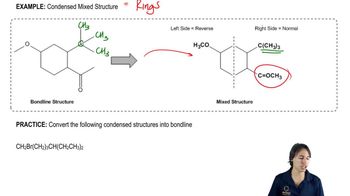
How to draw condensed mixed structures.