Ch. 6 - Stereoisomerism: Arrangement of Atoms in Space
Mullins - Organic Chemistry: A Learner Centered Approach 1st Edition
Mullins1st EditionOrganic Chemistry: A Learner Centered ApproachISBN: 9780137566471Non è quello che usi tu?Cambia libro di testo
Capitolo 5, Problema 9c

For each of the following molecules, draw a 3-D representation.
(c) CHBr3

Guida verificata passo dopo passo
1
Step 1: Recognize the molecular formula CHBr₃ as a derivative of methane (CH₄), where three hydrogen atoms are replaced by bromine atoms. This molecule is called bromoform.
Step 2: Identify the central atom in the molecule. Carbon (C) is the central atom because it forms four bonds and is surrounded by hydrogen (H) and bromine (Br) atoms.
Step 3: Determine the molecular geometry using VSEPR theory. Since carbon has four single bonds (one to hydrogen and three to bromine), the electron pairs around the carbon atom will arrange themselves to minimize repulsion. This results in a tetrahedral geometry.
Step 4: Place the atoms in a 3-D tetrahedral arrangement. Carbon is at the center, with one bond pointing straight up (to hydrogen) and the other three bonds pointing downward and outward (to bromine atoms). The bond angles are approximately 109.5°.
Step 5: Represent the 3-D structure using wedge-and-dash notation. Use a solid wedge to show a bond coming out of the plane, a dashed wedge for a bond going behind the plane, and straight lines for bonds in the plane. Assign the bromine atoms to the positions with larger spatial demand due to their size compared to hydrogen.

Risposta video verificata per un problema simile:

Questa soluzione video è stata consigliata dai nostri tutor come utile per risolvere questo problema.

Concetti chiave

Ecco i concetti essenziali che devi comprendere per rispondere correttamente alla domanda.

Molecular Geometry

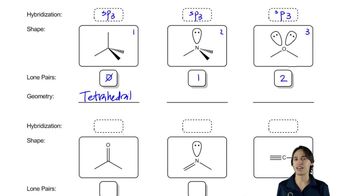
Molecular geometry refers to the three-dimensional arrangement of atoms within a molecule. It is determined by the number of bonding pairs and lone pairs of electrons around the central atom, which influences the shape of the molecule. Understanding molecular geometry is crucial for visualizing how molecules interact and react with one another.
Video consigliato:
07:44
Molecular Geometry Explained.

VSEPR Theory

Valence Shell Electron Pair Repulsion (VSEPR) theory is a model used to predict the geometry of individual molecules based on the repulsion between electron pairs in the valence shell of the central atom. According to VSEPR, electron pairs will arrange themselves to minimize repulsion, leading to specific molecular shapes. This theory is essential for accurately drawing 3-D representations of molecules like CHBr₃.
Video consigliato:
10:48
Equipment and Theory

Stereochemistry

Stereochemistry is the study of the spatial arrangement of atoms in molecules and how this affects their chemical behavior. It includes concepts such as chirality and geometric isomerism, which are important for understanding the 3-D structure of molecules. In the case of CHBr₃, recognizing the stereochemical aspects helps in accurately depicting its three-dimensional conformation.
Video consigliato:
Percorso guidato
1:38
Polymer Stereochemistry Concept 1