

Ch. 8 - Alkenes 1: Properties and Electrophilic Additions
Mullins - Organic Chemistry: A Learner Centered Approach 1st Edition
Mullins1st EditionOrganic Chemistry: A Learner Centered ApproachISBN: 9780137566471Non è quello che usi tu?Cambia libro di testo
Capitolo 7, Problema 58c

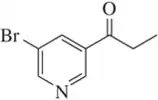
Calculate the index of hydrogen deficiency for the following molecular formulas and structures.
(c) Chemical structure of a brominated aromatic compound with a nitrogen atom and a carbonyl group.

Guida verificata passo dopo passo
1
Step 1: Understand the concept of the Index of Hydrogen Deficiency (IHD). IHD is a measure of the number of degrees of unsaturation in a molecule. Each degree of unsaturation corresponds to either a double bond, a ring, or a triple bond. The formula for IHD is: IHD = (2C + 2 - H + N - X)/2, where C is the number of carbons, H is the number of hydrogens, N is the number of nitrogens, and X is the number of halogens.
Step 2: Count the number of carbons (C), hydrogens (H), and oxygens (O) in the given structure. The molecular formula for the structure is C9H8O. Note that oxygen does not affect the IHD calculation.
Step 3: Apply the IHD formula. Substitute the values for C and H into the formula: IHD = (2(9) + 2 - 8)/2. Oxygen is ignored in the calculation.
Step 4: Analyze the structure visually. The benzene ring contributes 4 degrees of unsaturation (3 double bonds and 1 ring). The double bond in the side chain contributes 1 additional degree of unsaturation.
Step 5: Verify the calculated IHD value matches the structural features. The total degrees of unsaturation should account for the benzene ring and the double bond in the side chain, confirming the IHD calculation.

Risposta video verificata per un problema simile:

Questa soluzione video è stata consigliata dai nostri tutor come utile per risolvere questo problema.
Durata del video:
2m

Concetti chiave

Ecco i concetti essenziali che devi comprendere per rispondere correttamente alla domanda.

Index of Hydrogen Deficiency (IHD)

The Index of Hydrogen Deficiency (IHD) is a measure of the degree of unsaturation in a molecular structure, indicating the number of rings and/or multiple bonds present. It is calculated using the formula IHD = (2C + 2 + N - H - X) / 2, where C is the number of carbons, N is the number of nitrogens, H is the number of hydrogens, and X is the number of halogens. A higher IHD value suggests more unsaturation, which can affect the reactivity and properties of the compound.
Video consigliato:
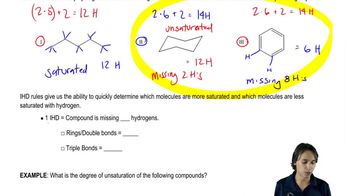
01:15
What index of hydrogen deficiency is.

Structural Representation of Organic Compounds

Understanding the structural representation of organic compounds is crucial for analyzing their properties and reactivity. Structures can be depicted in various ways, including Lewis structures, condensed formulas, and skeletal formulas. Each representation provides insights into the connectivity of atoms, functional groups, and the overall geometry of the molecule, which are essential for calculating the IHD and predicting chemical behavior.
Video consigliato:
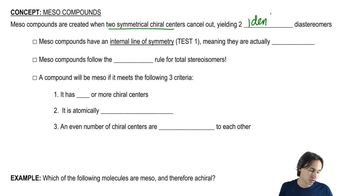
01:40
Defining meso compounds.

Functional Groups and Their Impact on IHD

Functional groups are specific groups of atoms within molecules that are responsible for the characteristic chemical reactions of those molecules. The presence of functional groups, such as carbonyls, alkenes, or aromatic rings, can significantly influence the IHD. For example, a carbonyl group contributes to the unsaturation of a compound, while aromatic rings introduce additional complexity due to their resonance and stability, affecting the overall calculation of hydrogen deficiency.
Video consigliato:
02:36
Identifying Functional Groups