Ch. 8 - Alkenes 1: Properties and Electrophilic Additions
Mullins - Organic Chemistry: A Learner Centered Approach 1st Edition
Mullins1st EditionOrganic Chemistry: A Learner Centered ApproachISBN: 9780137566471Non è quello che usi tu?Cambia libro di testo
Capitolo 7, Problema 20a(a)

The following reaction steps are shown using conventional electron pushing. (a) Draw the second product whose formation would have been rationalized with this same arrow.
(a)

Guida verificata passo dopo passo
1
Step 1: Analyze the reaction mechanism shown in the image. The first step involves protonation of the carbonyl oxygen atom by H⁺, as indicated by the curved arrow. This forms a positively charged intermediate with an OH group attached to the carbonyl carbon.
Step 2: Consider the possibility of bond rearrangement or cleavage. The positively charged intermediate is unstable, and the molecule may undergo further transformation to stabilize the charge.
Step 3: Identify the second product that could form. The protonation of the carbonyl group may lead to cleavage of the bond between the carbonyl carbon and the adjacent carbon, resulting in the formation of a carbocation and a neutral molecule.
Step 4: Rationalize the formation of the second product using electron-pushing arrows. The bond cleavage would be facilitated by the positive charge on the oxygen atom, which pulls electron density away from the carbonyl carbon.
Step 5: Draw the second product. The second product would likely be a smaller molecule formed by the cleavage of the bond, such as water (H₂O) or another neutral species, depending on the specific reaction conditions and intermediates.

Risposta video verificata per un problema simile:

Questa soluzione video è stata consigliata dai nostri tutor come utile per risolvere questo problema.

Concetti chiave

Ecco i concetti essenziali che devi comprendere per rispondere correttamente alla domanda.

Electron Pushing Mechanism

The electron pushing mechanism, often depicted using curved arrows, illustrates the movement of electron pairs during chemical reactions. This method helps visualize how nucleophiles attack electrophiles and how bonds are formed or broken. Understanding this mechanism is crucial for predicting the products of reactions and rationalizing the steps involved.
Video consigliato:
03:54
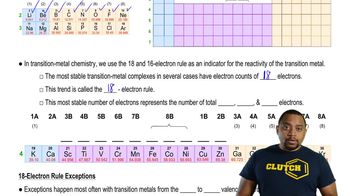
The 18 and 16 Electron Rule

Reaction Intermediates

Reaction intermediates are transient species formed during the conversion of reactants to products. They often have distinct structures and properties that can influence the course of the reaction. Identifying these intermediates is essential for understanding the overall reaction pathway and predicting the final products.
Video consigliato:
04:31
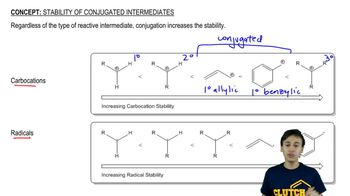
Stability of Conjugated Intermediates

Product Stability

The stability of reaction products is determined by factors such as sterics, electronics, and resonance. More stable products are generally favored in reactions, as they are lower in energy. Analyzing product stability helps in rationalizing which products are likely to form and in what proportions, guiding the prediction of outcomes in organic reactions.
Video consigliato:
05:58
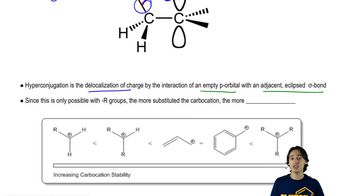
Determining Carbocation Stability