Ch. 8 - Alkenes 1: Properties and Electrophilic Additions
Mullins - Organic Chemistry: A Learner Centered Approach 1st Edition
Mullins1st EditionOrganic Chemistry: A Learner Centered ApproachISBN: 9780137566471Non è quello che usi tu?Cambia libro di testo
Capitolo 7, Problema 12b

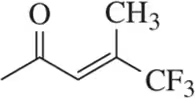
Which of the following alkenes are E and which are Z?
(b) Chemical structure of an alkene with a carbon chain, featuring a double bond and functional groups: O, CH3, and CF3.

Guida verificata passo dopo passo
1
Step 1: Understand the E/Z nomenclature. E (entgegen) and Z (zusammen) are used to describe the relative positions of the substituents on either side of a double bond. E means the higher-priority groups are on opposite sides, while Z means they are on the same side.
Step 2: Assign priorities to the substituents on each carbon of the double bond using the Cahn-Ingold-Prelog priority rules. The priority is determined based on atomic number; the higher the atomic number, the higher the priority.
Step 3: For the left carbon of the double bond, the substituents are Cl₃C (trichloromethyl group) and a hydrogen atom. Cl₃C has a higher priority because chlorine has a higher atomic number than hydrogen.
Step 4: For the right carbon of the double bond, the substituents are a methyl group (-CH₃) and a carbonyl group (-C=O). The carbonyl group has a higher priority because the oxygen atom bonded to the carbon has a higher atomic number than the hydrogen atoms in the methyl group.
Step 5: Determine the relative positions of the higher-priority groups (Cl₃C and -C=O). If they are on opposite sides of the double bond, the alkene is E. If they are on the same side, the alkene is Z.

Risposta video verificata per un problema simile:

Questa soluzione video è stata consigliata dai nostri tutor come utile per risolvere questo problema.
Durata del video:
5m

Concetti chiave

Ecco i concetti essenziali che devi comprendere per rispondere correttamente alla domanda.

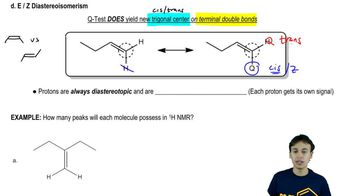
E/Z Isomerism

E/Z isomerism is a type of stereoisomerism that occurs in alkenes due to the restricted rotation around the double bond. The 'E' (entgegen) configuration indicates that the highest priority substituents on each carbon of the double bond are on opposite sides, while the 'Z' (zusammen) configuration indicates they are on the same side. This distinction is crucial for understanding the geometric arrangement of substituents in alkenes.
Video consigliato:
03:48
E/Z Diastereoisomerism

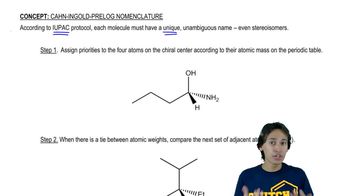
Cahn-Ingold-Prelog Priority Rules

The Cahn-Ingold-Prelog priority rules are used to determine the priority of substituents attached to the double-bonded carbons in alkenes. According to these rules, the substituent with the higher atomic number is given higher priority. If the first atoms are the same, one must consider the next atoms in the substituent chains until a difference is found, which is essential for correctly identifying E or Z configurations.
Video consigliato:
01:48
Why stereoisomers need their own naming system.

Substituent Analysis

Substituent analysis involves examining the groups attached to the double-bonded carbons to determine their relative positions. In the context of E/Z isomerism, it is important to identify the substituents on each carbon of the double bond and assess their priority. This analysis helps in visualizing the spatial arrangement of the groups, which is key to classifying the alkene as either E or Z.
Video consigliato:
01:47
Nucleophiles and Electrophiles can react in Substitution Reactions.