Ch. 8 - Alkenes 1: Properties and Electrophilic Additions
Mullins - Organic Chemistry: A Learner Centered Approach 1st Edition
Mullins1st EditionOrganic Chemistry: A Learner Centered ApproachISBN: 9780137566471Non è quello che usi tu?Cambia libro di testo
Capitolo 7, Problema 37b

Which reagent system (HBr or HBr, H2O2) would you use to carry out the following transformations?
(b) Chemical reaction showing alkene converting to alkyl bromide via anti-Markovnikov addition.

Guida verificata passo dopo passo
1
Identify the type of reaction: The problem involves the addition of HBr to an alkene, which can proceed via two different mechanisms depending on the presence of peroxides.
Understand the role of reagents: HBr alone will add to an alkene following Markovnikov's rule, where the hydrogen atom attaches to the less substituted carbon, and the bromine attaches to the more substituted carbon.
Consider the effect of peroxides: When HBr is used in the presence of peroxides (H₂O₂), the reaction follows an anti-Markovnikov addition. This means the bromine atom will attach to the less substituted carbon, and the hydrogen will attach to the more substituted carbon.
Analyze the desired product: Determine whether the transformation requires a Markovnikov or anti-Markovnikov addition by examining the position of the bromine in the target molecule.
Select the appropriate reagent system: Based on the desired product, choose HBr for Markovnikov addition or HBr with H₂O₂ for anti-Markovnikov addition.

Risposta video verificata per un problema simile:

Questa soluzione video è stata consigliata dai nostri tutor come utile per risolvere questo problema.
Durata del video:
3m

Concetti chiave

Ecco i concetti essenziali che devi comprendere per rispondere correttamente alla domanda.

Markovnikov's Rule

Markovnikov's Rule states that in the addition of HX to an alkene, the hydrogen atom will attach to the carbon with more hydrogen atoms, while the halide (X) will attach to the carbon with fewer hydrogen atoms. This rule helps predict the major product in electrophilic addition reactions.
Video consigliato:
03:54
The 18 and 16 Electron Rule

Anti-Markovnikov Addition

Anti-Markovnikov addition occurs when the addition of HX to an alkene results in the halide attaching to the less substituted carbon. This is typically observed in the presence of peroxides (H₂O₂) with HBr, where the reaction proceeds via a radical mechanism, leading to the opposite regioselectivity compared to Markovnikov's Rule.
Video consigliato:
02:43
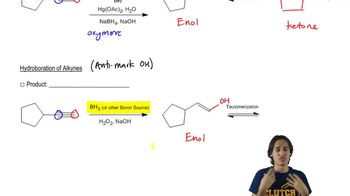
Anti-Markovnikov addition of alcohols to terminal alkynes yields aldehydes

Radical Mechanism

A radical mechanism involves the formation of free radicals, which are highly reactive species with unpaired electrons. In the presence of peroxides, HBr can initiate a radical chain reaction, leading to anti-Markovnikov addition. Understanding this mechanism is crucial for predicting the outcome of reactions involving radical initiators.
Video consigliato:
03:28
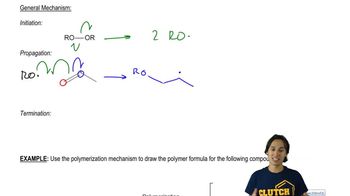
The mechanism of Radical Polymerization.