Ch. 8 - Alkenes 1: Properties and Electrophilic Additions
Mullins - Organic Chemistry: A Learner Centered Approach 1st Edition
Mullins1st EditionOrganic Chemistry: A Learner Centered ApproachISBN: 9780137566471Non è quello che usi tu?Cambia libro di testo
Capitolo 7, Problema 33

Would you expect but-2-ene or 2-methylbut-2-ene to react more quickly with HBr?
Comparison of hydrohalogenation reactions: but-2-ene vs. 2-methylbut-2-ene with HBr, showing product structures.

Guida verificata passo dopo passo
1
Identify the type of reaction: Both but-2-ene and 2-methylbut-2-ene will undergo an electrophilic addition reaction with HBr, where the alkene reacts with the hydrogen bromide to form a bromoalkane.
Consider the stability of the carbocation intermediate: In electrophilic addition reactions, the alkene forms a carbocation intermediate. The stability of this carbocation is crucial in determining the rate of the reaction.
Analyze the structure of but-2-ene: When but-2-ene reacts with HBr, it forms a secondary carbocation. Secondary carbocations are relatively stable, but not as stable as tertiary carbocations.
Analyze the structure of 2-methylbut-2-ene: When 2-methylbut-2-ene reacts with HBr, it forms a tertiary carbocation due to the presence of the methyl group, which provides additional stabilization through hyperconjugation and inductive effects.
Compare the stability of the carbocations: Tertiary carbocations are more stable than secondary carbocations. Therefore, 2-methylbut-2-ene, which forms a tertiary carbocation, is expected to react more quickly with HBr compared to but-2-ene, which forms a secondary carbocation.

Risposta video verificata per un problema simile:

Questa soluzione video è stata consigliata dai nostri tutor come utile per risolvere questo problema.
Durata del video:
1m

Concetti chiave

Ecco i concetti essenziali che devi comprendere per rispondere correttamente alla domanda.

Markovnikov's Rule

Markovnikov's Rule states that in the addition of HX (where X is a halogen) to an alkene, the hydrogen atom will attach to the carbon with more hydrogen atoms, and the halogen will attach to the carbon with fewer hydrogen atoms. This rule helps predict the major product of the reaction based on the stability of the carbocation intermediate.
Video consigliato:
03:54
The 18 and 16 Electron Rule

Carbocation Stability

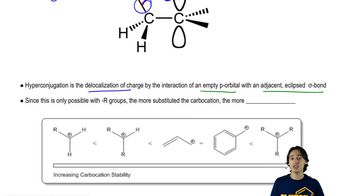
Carbocation stability is crucial in determining the rate of alkene reactions with HX. Tertiary carbocations are more stable than secondary or primary ones due to hyperconjugation and inductive effects. In the reaction of alkenes with HBr, the formation of a more stable carbocation intermediate leads to a faster reaction rate.
Video consigliato:
05:58
Determining Carbocation Stability

Steric Hindrance

Steric hindrance refers to the resistance encountered by a chemical reaction due to the size of groups within a molecule. In alkenes, bulky substituents can slow down reactions by impeding the approach of reactants. Comparing but-2-ene and 2-methylbut-2-ene, the latter has more steric hindrance due to the methyl group, potentially affecting its reactivity with HBr.
Video consigliato:
02:53
Understanding steric effects.