Ch. 9 - Alkenes 2: Oxidation and Reduction
Mullins - Organic Chemistry: A Learner Centered Approach 1st Edition
Mullins1st EditionOrganic Chemistry: A Learner Centered ApproachISBN: 9780137566471Non è quello che usi tu?Cambia libro di testo
Capitolo 8, Problema 43b

Calculate the oxidation number for the indicated carbons.
(b) Chemical structure of aniline with a blue arrow pointing to the carbon bonded to the NH2 group.

Guida verificata passo dopo passo
1
Identify the carbon atom for which you need to calculate the oxidation number. In organic molecules, this is often indicated by a specific label or context in the problem.
Determine the number of bonds the carbon atom forms with more electronegative atoms (such as oxygen, nitrogen, or halogens). Each bond to a more electronegative atom increases the oxidation state by +1.
Determine the number of bonds the carbon atom forms with less electronegative atoms (such as hydrogen). Each bond to a less electronegative atom decreases the oxidation state by -1.
Consider any bonds the carbon atom forms with other carbon atoms. These typically do not affect the oxidation state, as the electronegativity is the same.
Sum the contributions from each bond to determine the oxidation number of the carbon atom. Remember that the oxidation number is a formalism and may not represent the actual charge on the atom.

Risposta video verificata per un problema simile:

Questa soluzione video è stata consigliata dai nostri tutor come utile per risolvere questo problema.

Concetti chiave

Ecco i concetti essenziali che devi comprendere per rispondere correttamente alla domanda.

Oxidation Number

The oxidation number is a theoretical charge assigned to an atom in a molecule, reflecting its electron control relative to a neutral atom. It helps in determining the electron transfer in redox reactions. For carbon, it is calculated by considering the electronegativity of atoms bonded to it and assigning electrons accordingly.
Video consigliato:
03:40
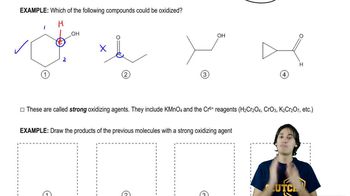
Strong oxidizing agents

Electronegativity

Electronegativity is the tendency of an atom to attract electrons towards itself in a chemical bond. In organic chemistry, it is crucial for determining the oxidation number, as electrons are assigned to the more electronegative atom in a bond. Carbon's electronegativity is intermediate, affecting its oxidation state in compounds.
Video consigliato:
1:47
Electronegativity

Redox Reactions

Redox reactions involve the transfer of electrons between atoms, leading to changes in oxidation states. Understanding these reactions is essential for calculating oxidation numbers, as they indicate how electrons are distributed in a molecule. In organic chemistry, redox processes are key in metabolic pathways and synthetic transformations.
Video consigliato:
06:02
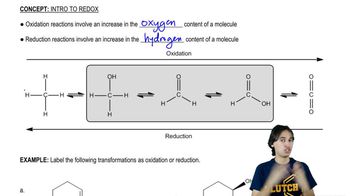
General Features of Redox