Ch. 9 - Alkenes 2: Oxidation and Reduction
Mullins - Organic Chemistry: A Learner Centered Approach 1st Edition
Mullins1st EditionOrganic Chemistry: A Learner Centered ApproachISBN: 9780137566471Non è quello che usi tu?Cambia libro di testo
Capitolo 8, Problema 56

Ozonolysis of an unknown alkene A gives the products shown. Predict the product that results from hydrogenation of alkene A. [There are multiple answers, but only show the one with the 6-membered ring.]

Guida verificata passo dopo passo
1
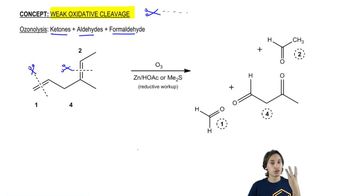
Identify the products of ozonolysis: The image shows two carbonyl compounds resulting from the cleavage of the alkene A. These are a ketone and an aldehyde.
Determine the structure of alkene A: Ozonolysis breaks the double bond of the alkene, forming two carbonyl groups. The presence of a ketone and an aldehyde suggests that alkene A was a cyclic structure, likely a 6-membered ring, with the double bond between two specific carbon atoms.
Predict the structure of alkene A: Based on the ozonolysis products, alkene A is likely cyclohexene, where the double bond is between the first and second carbon atoms, forming a 6-membered ring.
Understand hydrogenation: Hydrogenation involves the addition of hydrogen (H₂) across the double bond of an alkene, converting it into an alkane. In the presence of a catalyst like Pd/C, the double bond in cyclohexene will be reduced.
Predict the product of hydrogenation: The hydrogenation of cyclohexene will result in cyclohexane, a saturated 6-membered ring with no double bonds.

Risposta video verificata per un problema simile:

Questa soluzione video è stata consigliata dai nostri tutor come utile per risolvere questo problema.

Concetti chiave

Ecco i concetti essenziali che devi comprendere per rispondere correttamente alla domanda.

Ozonolysis

Ozonolysis is a reaction where ozone (O3) cleaves alkenes to form carbonyl compounds. In this process, the double bond of the alkene is broken, and each carbon atom of the double bond is converted into a carbonyl group. This reaction helps identify the structure of the original alkene by analyzing the resulting carbonyl compounds.
Video consigliato:
06:30
General properties of ozonolysis.

Hydrogenation

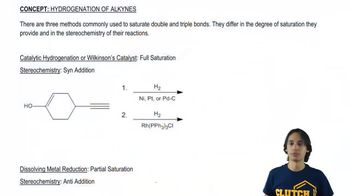
Hydrogenation is a chemical reaction that involves the addition of hydrogen (H2) to unsaturated bonds, typically in the presence of a catalyst like palladium on carbon (Pd/C). This process converts alkenes into alkanes by saturating the double bonds, resulting in a more stable, single-bonded structure. In the context of cyclic compounds, hydrogenation can lead to the formation of cycloalkanes.
Video consigliato:
00:48
The definition of hydrogenation.

Six-membered ring formation

Six-membered rings are a common structural motif in organic chemistry, known for their stability due to minimal angle strain. When predicting products from reactions like hydrogenation, identifying potential six-membered ring formations is crucial, as they often represent the most stable cyclic structures. Understanding the formation of these rings helps in predicting the final product's structure.
Video consigliato:
05:14
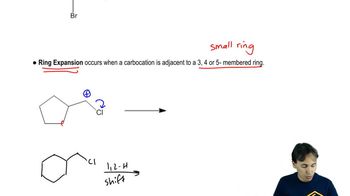
Ring Expansion
Pratica correlata
Domanda del libro di testo

Bromination of a highly electron-rich alkene such as 2-methoxybut-2-ene has been shown to produce approximately equal mixtures of the trans- and cis-dibromide. Suggest an explanation for this observation.

1635
views

Domanda del libro di testo

In Chapter 19, we discuss the reaction of enols with bromine. This reaction produces α -bromoketones in good yields. Suggest a mechanism for this reaction and justify its deviation from the dibromide product you might have expected.

1958
views
Domanda del libro di testo

At the beginning of Chapter 9, we stated that after finishing Chapters 8 and 9, we would have the ability to make a large variety of functional groups using related reactions. Show the reagent(s) necessary to convert 1-isobutylcyclohexene into the following molecules.

(a)

1157
views
Domanda del libro di testo

In spite of being mechanistically similar to some of the reactions we saw in Chapter 8, rearrangement never occurred here in Chapter 9. Why doesn't rearrangement occur in the following bromination reaction despite the proximity of a more substituted carbon?

947
views
Domanda del libro di testo

Predict the product of ozonolysis of the triglyceride shown.

1243
views
Domanda del libro di testo

At the beginning of Chapter 9, we stated that after finishing Chapters 8 and 9, we would have the ability to make a large variety of functional groups using related reactions. Show the reagent(s) necessary to convert 1-isobutylcyclohexene into the following molecules.

(b)

1178
views