Rank the reactivity of the following alkenes with mCPBA ( 1 = most reactive , 5 least reactive ).
Ch. 9 - Alkenes 2: Oxidation and Reduction

Mullins1st EditionOrganic Chemistry: A Learner Centered ApproachISBN: 9780137566471Non è quello che usi tu?Cambia libro di testo
Tutti i libri di testo
Mullins 1st Edition
Ch. 9 - Alkenes 2: Oxidation and Reduction
Problema 45l(ix,x)
Mullins 1st Edition
Ch. 9 - Alkenes 2: Oxidation and Reduction
Problema 45l(ix,x)Capitolo 8, Problema 45l(ix,x)
Predict the product(s) that would result when the alkenes are allowed to react under the following conditions: (ix) H2, Pd/C; and (x) D2, Pd/C.
(l) 
Guida verificata passo dopo passo1
Step 1: Analyze the structure of the given alkene. The molecule contains a double bond, which is the reactive site for hydrogenation reactions. The double bond is located between two carbon atoms in the chain.
Step 2: Understand the reaction conditions. (ix) H₂, Pd/C involves catalytic hydrogenation, where molecular hydrogen (H₂) adds across the double bond in the presence of a palladium catalyst. This results in the conversion of the alkene to an alkane by adding two hydrogen atoms to the carbons of the double bond.
Step 3: For (x) D₂, Pd/C, the reaction is similar to (ix), but instead of H₂, deuterium gas (D₂) is used. Deuterium is an isotope of hydrogen, so the double bond will be saturated with deuterium atoms instead of hydrogen atoms.
Step 4: Predict the stereochemistry of the product. The addition of H₂ or D₂ across the double bond occurs in a syn fashion, meaning both hydrogen or deuterium atoms will add to the same face of the double bond. This is due to the surface mechanism of the Pd/C catalyst.
Step 5: Consider the chirality of the molecule. If the addition of H₂ or D₂ creates new chiral centers, the product will be a mixture of stereoisomers (enantiomers or diastereomers) depending on the original structure of the alkene.

Risposta video verificata per un problema simile:
Questa soluzione video è stata consigliata dai nostri tutor come utile per risolvere questo problema.
Durata del video:
4mConcetti chiave
Ecco i concetti essenziali che devi comprendere per rispondere correttamente alla domanda.
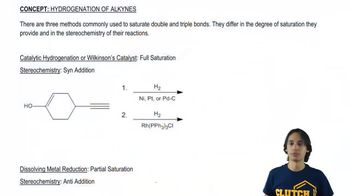
Hydrogenation
Hydrogenation is a chemical reaction that involves the addition of hydrogen (H₂) to an alkene or alkyne, converting it into an alkane. This reaction typically requires a catalyst, such as palladium on carbon (Pd/C), which facilitates the breaking of the double bond in the alkene, allowing hydrogen atoms to add across it. The result is a saturated hydrocarbon, which is generally more stable than the original unsaturated compound.
Video consigliato:
The definition of hydrogenation.
Deuteration
Deuteration is similar to hydrogenation but involves the addition of deuterium (D₂), a stable isotope of hydrogen, instead of regular hydrogen. This process also requires a catalyst like Pd/C and results in the formation of deuterated alkanes. Deuteration is often used in organic chemistry for tracing reactions and studying mechanisms due to the unique properties of deuterium compared to hydrogen.
Catalytic Activity of Pd/C
Palladium on carbon (Pd/C) is a widely used catalyst in organic reactions, particularly in hydrogenation and deuteration processes. The palladium provides active sites for the adsorption of hydrogen or deuterium, facilitating the addition to alkenes. The carbon support enhances the dispersion of palladium, increasing its surface area and catalytic efficiency, making it an effective choice for these types of reactions.
Video consigliato:
Percorso guidato
Catalytic Allylic Alkylation Concept 1
Pratica correlata
Domanda del libro di testo
1675
views
Domanda del libro di testo
Predict the product(s) that would result when the alkenes are allowed to react under the following conditions: (vii) 1. mCPBA 2. H2SO4, H2O (viii) 1. O3 2. CH3SCH3
(l)
726
views
Domanda del libro di testo
Predict the product(s) that would result when the alkenes are allowed to react under the following conditions: (iii) Br2, H2O
(k)
1155
views
Domanda del libro di testo
Predict the product(s) that would result when the alkenes are allowed to react under the following conditions: (i) Br2 (ii) Cl2
(l)
740
views
Domanda del libro di testo
Predict the product(s) that would result when the alkenes are allowed to react under the following conditions: (iii) Br2, H2O ; (iv) Cl2, CH3OH;
(l)
708
views
Domanda del libro di testo
Predict the product(s) that would result when the alkenes are allowed to react under the following conditions: (v) mCPBA; (vi) 1. OsO4 2. NaHSO3
(l)
1010
views