Ch. 9 - Alkenes 2: Oxidation and Reduction
Mullins - Organic Chemistry: A Learner Centered Approach 1st Edition
Mullins1st EditionOrganic Chemistry: A Learner Centered ApproachISBN: 9780137566471Non è quello che usi tu?Cambia libro di testo
Capitolo 8, Problema 45f(vii,viii)

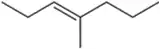
Predict the product(s) that would result when the alkenes are allowed to react under the following conditions: (vii) 1. mCPBA 2. (viii) 1. O3 2. CH3SCH3
(f) Structural representation of an alkene with a double bond, illustrating a reaction mechanism for ozonolysis.

Guida verificata passo dopo passo
1
Step 1: Analyze the given alkene structure. The molecule contains a double bond in the middle of the chain, which will be the reactive site for the given reagents.
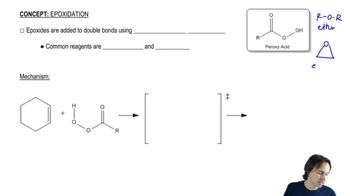
Step 2: For reaction (vii) with mCPBA (meta-chloroperoxybenzoic acid), this reagent is used to perform an epoxidation reaction. The double bond will react with mCPBA to form an epoxide (a three-membered cyclic ether).
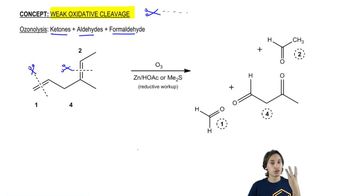
Step 3: For reaction (viii) with O₃ (ozone) followed by CH₃SCH₃ (dimethyl sulfide), this is an ozonolysis reaction. Ozone cleaves the double bond, and the dimethyl sulfide reduces the ozonide intermediate to form aldehydes or ketones depending on the substituents attached to the double bond.
Step 4: Identify the products for each reaction. For (vii), the product will be an epoxide formed across the double bond. For (viii), the double bond will be cleaved, and two carbonyl compounds will be formed at the positions where the double bond was located.
Step 5: Draw the structures of the products for both reactions to confirm the outcomes. Ensure that the stereochemistry (if applicable) and the functional groups are correctly represented in the final products.

Risposta video verificata per un problema simile:

Questa soluzione video è stata consigliata dai nostri tutor come utile per risolvere questo problema.
Durata del video:
4m

Concetti chiave

Ecco i concetti essenziali che devi comprendere per rispondere correttamente alla domanda.

Epoxidation

Epoxidation is a reaction where an alkene is converted into an epoxide, a three-membered cyclic ether. This transformation typically occurs using peracids, such as m-chloroperbenzoic acid (mCPBA). The reaction involves the electrophilic attack of the peracid on the double bond, resulting in the formation of the epoxide and a carboxylic acid as a byproduct.
Video consigliato:
02:19
General properties of epoxidation.

Ozonolysis

Ozonolysis is a reaction involving the cleavage of alkenes using ozone (O₃), followed by a reductive workup, often with a thiol like dimethyl sulfide (CH₃SCH₃). This process results in the formation of carbonyl compounds, such as aldehydes or ketones, depending on the structure of the alkene. It is a valuable method for determining the structure of alkenes and synthesizing carbonyl compounds.
Video consigliato:
06:30
General properties of ozonolysis.

Reaction Mechanisms

Understanding reaction mechanisms is crucial in organic chemistry as it explains the step-by-step process by which reactants are converted into products. For both epoxidation and ozonolysis, knowing the mechanism helps predict the products formed and the conditions required for the reactions. This knowledge is essential for designing synthetic pathways and understanding the reactivity of different functional groups.
Video consigliato:
02:16
Heck Reaction Mechanism