Ch. 9 - Alkenes 2: Oxidation and Reduction
Mullins - Organic Chemistry: A Learner Centered Approach 1st Edition
Mullins1st EditionOrganic Chemistry: A Learner Centered ApproachISBN: 9780137566471Non è quello che usi tu?Cambia libro di testo
Capitolo 8, Problema 47

When alkenes react with bromine in water, a halohydrin is produced. When water is replaced with methanol in this reaction, a different product is produced. Suggest a mechanism for the formation of this product.
Chemical reaction diagram showing the formation of a halohydrin from an alkene with bromine and methanol.

Guida verificata passo dopo passo
1
Step 1: Begin by understanding the reaction conditions. The reaction involves an alkene reacting with bromine (Br₂) in the presence of methanol (CH₃OH) instead of water. Methanol acts as a nucleophile in this case.
Step 2: The first step in the mechanism is the electrophilic addition of bromine to the alkene. The π-electrons of the alkene attack the bromine molecule, leading to the formation of a bromonium ion intermediate. This intermediate is a three-membered ring structure where one bromine atom is positively charged.
Step 3: Methanol, being a nucleophile, attacks the bromonium ion. The attack occurs at the more substituted carbon of the bromonium ion due to steric and electronic factors, leading to the opening of the ring. This step results in the formation of a product where methanol is attached to one carbon and bromine to the other.
Step 4: After the nucleophilic attack, the proton on the methanol group is removed by a base (often the bromide ion, Br⁻, generated in the reaction). This deprotonation step stabilizes the product and completes the reaction.
Step 5: The final product is an ether derivative, specifically a bromomethoxy compound, where the alkene has been converted into a molecule with a bromine atom and a methoxy group (-OCH₃) attached to adjacent carbons.

Risposta video verificata per un problema simile:

Questa soluzione video è stata consigliata dai nostri tutor come utile per risolvere questo problema.

Concetti chiave

Ecco i concetti essenziali che devi comprendere per rispondere correttamente alla domanda.

Electrophilic Addition

Electrophilic addition is a fundamental reaction mechanism for alkenes, where an electrophile reacts with the double bond of the alkene. In the case of bromine reacting with alkenes, the bromine molecule becomes polarized, allowing the bromine cation to add to one carbon of the double bond while the other carbon forms a bond with a nucleophile, such as water or methanol, leading to the formation of a halohydrin or an ether.
Video consigliato:
09:23
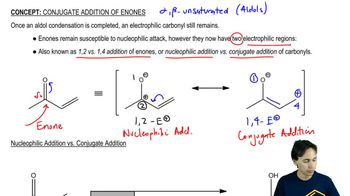
1,2 vs 1,4 Addition

Nucleophilic Substitution

Nucleophilic substitution is a reaction where a nucleophile replaces a leaving group in a molecule. In the context of the reaction with methanol, the methanol acts as a nucleophile, attacking the positively charged carbon that results from the electrophilic addition of bromine. This substitution leads to the formation of an ether instead of a halohydrin, showcasing how the solvent can influence the product of the reaction.
Video consigliato:
01:47
Nucleophiles and Electrophiles can react in Substitution Reactions.

Regioselectivity

Regioselectivity refers to the preference of a chemical reaction to yield one structural isomer over others when multiple possibilities exist. In the reaction of alkenes with bromine in different solvents, the regioselectivity is influenced by the nature of the nucleophile (water vs. methanol) and the stability of the carbocation intermediate formed during the reaction. Understanding regioselectivity is crucial for predicting the major product in these reactions.
Video consigliato:
05:09
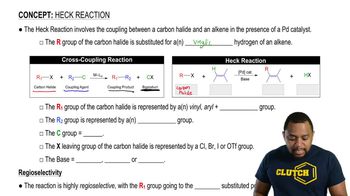
Heck Reaction