Ch.1 - Structure and Bonding
Wade - Organic Chemistry 9th Edition
Wade9th EditionOrganic ChemistryISBN: 9780135213728Non è quello che usi tu?Cambia libro di testo
Capitolo 1, Problema 7d,e,f

Draw the important resonance forms for the following molecules and ions.
(d) NO3–
(e) NO2–
(f)

Guida verificata passo dopo passo
1
Identify the molecule or ion for which you need to draw resonance structures. For NO3- (nitrate ion), NO2- (nitrite ion), and HCOCH=CHCH2- (a carbonyl compound with an allylic anion), start by drawing the Lewis structure.
For NO3-, draw the central nitrogen atom bonded to three oxygen atoms. Include a negative charge on one of the oxygen atoms. Consider the possibility of delocalizing the negative charge across the oxygen atoms to form resonance structures.
For NO2-, draw the central nitrogen atom bonded to two oxygen atoms. Place a negative charge on one of the oxygen atoms. Explore the resonance structures by moving the negative charge and forming double bonds with the nitrogen atom.
For HCOCH=CHCH2-, identify the allylic position (the carbon atom adjacent to the double bond) where the negative charge is located. Draw resonance structures by moving the pi electrons of the double bond to form new double bonds and shift the negative charge.
Ensure that all resonance structures obey the rules of resonance: atoms must remain in the same positions, only electrons move, and the overall charge of the molecule or ion remains constant. Check that each structure has valid Lewis structures with complete octets where applicable.

Risposta video verificata per un problema simile:

Questa soluzione video è stata consigliata dai nostri tutor come utile per risolvere questo problema.
Durata del video:
8m

Concetti chiave

Ecco i concetti essenziali che devi comprendere per rispondere correttamente alla domanda.

Resonance

Resonance in organic chemistry refers to the phenomenon where a molecule or ion can be represented by two or more valid Lewis structures, known as resonance forms. These forms differ only in the placement of electrons, not atoms, and help depict the delocalization of electrons within the molecule, providing a more accurate representation of its electronic structure.
Video consigliato:
03:04
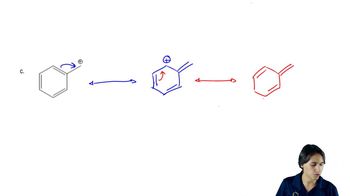
Drawing Resonance Structures

Formal Charge

Formal charge is a concept used to determine the charge distribution within a molecule. It is calculated by assuming equal sharing of electrons in bonds and comparing the number of valence electrons in an isolated atom to those assigned in the molecule. Understanding formal charge helps in identifying the most stable resonance structures, as structures with minimized formal charges are generally more stable.
Video consigliato:
01:34
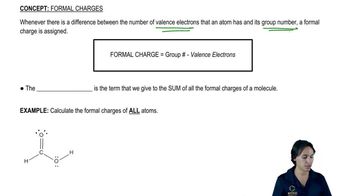
Calculating formal and net charge.

Electron Delocalization

Electron delocalization is the spreading of electron density across multiple atoms, which occurs in molecules with conjugated systems or resonance. This delocalization stabilizes the molecule by lowering its energy, and is often depicted in resonance structures. Recognizing electron delocalization is crucial for drawing resonance forms, as it explains the distribution of electrons across the molecule.
Video consigliato:
03:54
The 18 and 16 Electron Rule