Indietro
- 1. Draw the structure of cis-CH3CH=CHCH2CH3 showing the pi bond with its proper geometry. 2. Draw the trans isomer, and circle the coplanar atoms. Are there still six?
Problema 1

Problema 1a
If a hydrocarbon has nine carbon atoms, three double bonds, and one ring, how many hydrogen atoms must it have?
Hint: If you prefer to use a formula, elements of unsaturation = 1/2(2C + 2 - H)
C = number of carbons
H = number of hydrogens
Problema 1b
Calculate the number of elements of unsaturation implied by the molecular formula C6H12.
Hint: If you prefer to use a formula, elements of unsaturation = 1/2(2C + 2 - H)
C = number of carbons
H = number of hydrogens
Problema 1c
Give five examples of structures with this formula (C6H12). At least one should contain a ring, and at least one should contain a double bond.
Hint: If you prefer to use a formula, elements of unsaturation = 1/2(2C + 2 - H)
C = number of carbons
H = number of hydrogens
Problema 2
Determine the number of elements of unsaturation in the molecular formula C4H6. Give all nine possible structures having this formula. Remember that
a double bond = one element of unsaturation
a ring = one element of unsaturation
a triple bond = two elements of unsaturation
Problema 3a
Draw five more compounds of formula C4H6NOCl.
Problema 4a,b,c
For each of the following molecular formulas, determine the number of elements of unsaturation, and draw three examples.
a. C4H4Cl2
b. C4H8O
c. C6H8O2
Problema 4d,e
For each of the following molecular formulas, determine the number of elements of unsaturation, and draw three examples.
d. C5H5NO2
e. C6H3NClBr
Problema 5a,b
Give the systematic (IUPAC) names of the following alkenes.
(a)
(b)
Problema 5d,e
Give the systematic (IUPAC) names of the following alkenes.
(d)
(e)
Problema 5f,g
Give the systematic (IUPAC) names of the following alkenes.
(f)
(g)
Problema 6a,b
1. Determine which of the following compounds show cis-trans isomerism.
2. Draw and name the cis and trans (or Z and E) isomers of those that do.
a. hex-3-ene
b.buta-1,3-diene
Problema 6c,d
1. Determine which of the following compounds show cis-trans isomerism.
2. Draw and name the cis and trans (or Z and E) isomers of those that do.
c. hexa-2,4-diene
d. 3-methylpent-2-ene
Problema 6e,f
1. Determine which of the following compounds show cis-trans isomerism.
2. Draw and name the cis and trans (or Z and E) isomers of those that do.
e. 2,3-dimethylpent-2-ene
f. 3,4-dibromocyclopentene
Problema 7a,b
The following names are all incorrect. Draw the structure represented by the incorrect name (or a consistent structure if the name is ambiguous), and give your drawing the correct name.
a. cis-dimethylpent-2-ene
b. 3-vinylhex-4-ene
Problema 7-25b
For each reaction, decide whether substitution or elimination (or both) is possible, and predict the products you expect. Label the major products.
b. 1-bromo-1-methylcyclohexane + triethylamine(Et3N:)
Problema 7c,d
The following names are all incorrect. Draw the structure represented by the incorrect name (or a consistent structure if the name is ambiguous), and give your drawing the correct name.
c. 2-methylcyclopentene
d. 6-chlorocyclohexadiene
Problema 7e
The following names are all incorrect. Draw the structure represented by the incorrect name (or a consistent structure if the name is ambiguous), and give your drawing the correct name.
e. 2,5-dimethylcyclohexene
Problema 8a,b
Some of the following examples can show geometric isomerism, and some cannot. For the ones that can, draw all the geometric isomers, and assign complete names using the E-Z system.
a. 3-bromo-2-chloropent-2-ene
b. 3-ethylhexa-2,4-diene
Problema 8c,d
Some of the following examples can show geometric isomerism, and some cannot. For the ones that can, draw all the geometric isomers, and assign complete names using the E-Z system.
c. 3-bromo-2-methylhex-3-ene
d. penta-1,3-diene
Problema 8e,f
Some of the following examples can show geometric isomerism, and some cannot. For the ones that can, draw all the geometric isomers, and assign complete names using the E-Z system.
e. 3-ethyl-5-methyloct-3-ene
f. 3,7-dichloroocta-2,5-diene
Problema 8g,h
Some of the following examples can show geometric isomerism, and some cannot. For the ones that can, draw all the geometric isomers, and assign complete names using the E-Z system.
(g)
(h)
Problema 8i
Some of the following examples can show geometric isomerism, and some cannot. For the ones that can, draw all the geometric isomers, and assign complete names using the E-Z system.
(i)
Problema 9a
How many stereogenic double bonds are in octa-1,3,5-triene? How many stereocenters are there? Draw and name the four stereoisomers of octa-1,3,5-triene.
Problema 9b
Draw the six stereoisomers of octa-2,4,6-triene. Explain why there are only six stereoisomers, rather than the eight we might expect for a compound with three stereogenic double bonds.
Problema 10a
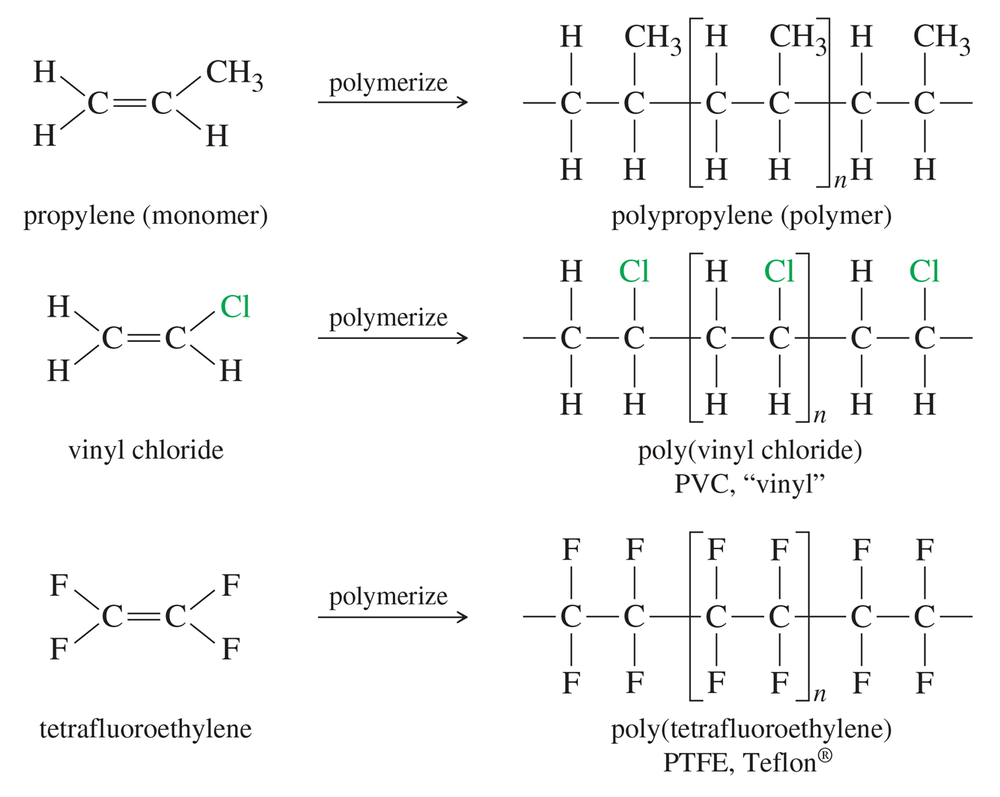
Teflon-coated frying pans routinely endure temperatures that would cause polyethylene or polypropylene to oxidize and decompose. Decomposition of polyethylene is initiated by free-radical abstraction of a hydrogen atom by O2. Bond-dissociation energies of C—H bonds are about 400 kJ/mol, and C—F bonds are about 460 kJ/mol. The BDE of the H—OO bond is about 192 kJ/mol, and the F—OO bond is about 63 kJ/mol. Show why Teflon (Figure 7-5) is much more resistant to oxidation than polyethylene is.
Problema 11a
For each pair of compounds, predict the one with a higher boiling point. Which compounds have zero dipole moments?
a. cis-1,2-dichloroethene or cis-1,2-dibromoethene
Problema 11b
For each pair of compounds, predict the one with a higher boiling point. Which compounds have zero dipole moments?
b. cis- or trans-2,3-dichlorobut-2-ene
Problema 11c
For each pair of compounds, predict the one with a higher boiling point. Which compounds have zero dipole moments?
c. cyclohexene or 1,2-dichlorocyclohexene
Problema 12
Use the data in Table 7-2 to predict the energy difference between 2,3-dimethylbut-1-ene and 2,3-dimethylbut-2-ene. Which of these double-bond isomers is more stable?