

Ch.1 - Structure and Bonding
Wade - Organic Chemistry 9th Edition
Wade9th EditionOrganic ChemistryISBN: 9780135213728Non è quello che usi tu?Cambia libro di testo
Capitolo 1, Problema 22

For each pair of structures, determine whether they represent different compounds or a single compound.

Guida verificata passo dopo passo
1
Examine the connectivity of atoms in each pair of structures. Determine if the atoms are connected in the same sequence (same connectivity) or if there are differences in the bonding pattern.
Check for stereochemistry in the structures. Look for chiral centers, double bonds with cis/trans (E/Z) isomerism, or other stereochemical features that might distinguish the compounds.
Determine if the structures are related by a conformational change (e.g., rotation around a single bond). If they are, they represent the same compound in different conformations.
If the structures have the same connectivity but differ in stereochemistry, classify them as stereoisomers. If they have different connectivity, classify them as different compounds.
Summarize your findings for each pair of structures, specifying whether they represent the same compound, stereoisomers, or different compounds based on the analysis above.

Risposta video verificata per un problema simile:

Questa soluzione video è stata consigliata dai nostri tutor come utile per risolvere questo problema.
Durata del video:
2m

Concetti chiave

Ecco i concetti essenziali che devi comprendere per rispondere correttamente alla domanda.

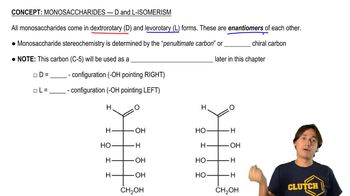
Isomerism

Isomerism refers to the phenomenon where two or more compounds have the same molecular formula but differ in the arrangement of atoms. This can lead to different physical and chemical properties. Isomers can be classified into structural isomers, which differ in connectivity, and stereoisomers, which differ in spatial arrangement.
Video consigliato:
06:47
Monosaccharides - D and L Isomerism

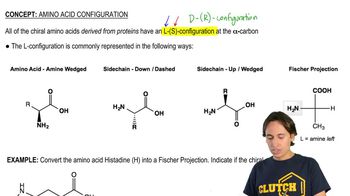
Structural Representation

Structural representation involves depicting the arrangement of atoms within a molecule, often using Lewis structures or skeletal formulas. Understanding these representations is crucial for identifying whether two structures are the same compound or different, as even slight variations in structure can indicate different compounds.
Video consigliato:
05:09
Representations of L-Configuration

Functional Groups

Functional groups are specific groups of atoms within molecules that are responsible for the characteristic chemical reactions of those molecules. Recognizing functional groups is essential for determining the identity of a compound and can help differentiate between isomers, as different functional groups can lead to distinct chemical behaviors.
Video consigliato:
02:36
Identifying Functional Groups