Ch.1 - Structure and Bonding
Wade - Organic Chemistry 9th Edition
Wade9th EditionOrganic ChemistryISBN: 9780135213728Non è quello che usi tu?Cambia libro di testo
Capitolo 1, Problema 5f-j

Use electronegativities to predict the direction of the dipole moments of the following bonds.
(f) N—Cl
(g) N—O
(h) N—S
(i) N—B
(j) B—Cl

Guida verificata passo dopo passo
1
Identify the electronegativity values of each element involved in the bonds. For example, nitrogen (N), chlorine (Cl), oxygen (O), sulfur (S), and boron (B) have specific electronegativity values.
Compare the electronegativity values of the two atoms in each bond. The atom with the higher electronegativity will attract the shared electrons more strongly, creating a dipole moment.
For the N—Cl bond, compare the electronegativity of nitrogen and chlorine. Determine which atom is more electronegative and predict the direction of the dipole moment towards that atom.
For the N—O bond, compare the electronegativity of nitrogen and oxygen. Determine which atom is more electronegative and predict the direction of the dipole moment towards that atom.
Repeat the process for the N—S, N—B, and B—Cl bonds, comparing the electronegativities of the atoms in each bond and predicting the direction of the dipole moment towards the more electronegative atom.

Risposta video verificata per un problema simile:

Questa soluzione video è stata consigliata dai nostri tutor come utile per risolvere questo problema.
Durata del video:
3m

Concetti chiave

Ecco i concetti essenziali che devi comprendere per rispondere correttamente alla domanda.

Electronegativity

Electronegativity is a measure of an atom's ability to attract and hold onto electrons within a chemical bond. In a bond between two atoms, the atom with higher electronegativity will attract the shared electrons more strongly, creating a dipole moment. Understanding electronegativity differences is crucial for predicting the direction of dipole moments in bonds.
Video consigliato:
1:47
Electronegativity

Dipole Moment

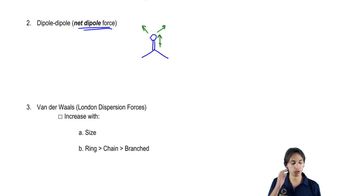
A dipole moment occurs when there is an uneven distribution of electron density in a chemical bond, resulting in a partial positive and partial negative charge. The direction of the dipole moment is from the less electronegative atom to the more electronegative atom. Dipole moments are vector quantities and are essential for understanding molecular polarity.
Video consigliato:
01:46
How dipole-dipole forces work.

Bond Polarity

Bond polarity arises from differences in electronegativity between two bonded atoms. A polar bond has a significant electronegativity difference, leading to a dipole moment, while a nonpolar bond has little to no difference. Recognizing bond polarity helps in predicting molecular behavior and interactions, such as solubility and reactivity.
Video consigliato:
06:00
Single bonds, double bonds, and triple bonds.