Ch. 2 - Acids and Bases; Functional Groups
Wade - Organic Chemistry 9th Edition
Wade9th EditionOrganic ChemistryISBN: 9780135213728Non è quello che usi tu?Cambia libro di testo
Capitolo 2, Problema 26i,j

Draw a Lewis structure, and classify each of the following compounds:
(i)
(j)

Guida verificata passo dopo passo
1
Step 1: Identify the functional groups in each compound. Compound (i) contains an ester group, characterized by a carbonyl group (C=O) adjacent to an ether linkage (C-O-C). Compound (j) contains a secondary amine group, characterized by a nitrogen atom bonded to two carbon atoms, one of which is part of a methyl group (CH₃).
Step 2: Draw the Lewis structure for compound (i). Start by drawing the carbon skeleton of the five-membered ring. Add the carbonyl group (C=O) to one of the carbon atoms, and the ether linkage (C-O-C) to the adjacent carbon atom. Ensure that each atom has a complete octet, except for hydrogen, which should have a duet.
Step 3: Draw the Lewis structure for compound (j). Begin by drawing the six-membered ring. Add the nitrogen atom to one of the carbon atoms in the ring. Attach the methyl group (CH₃) to the nitrogen atom. Ensure that each atom has a complete octet, except for hydrogen, which should have a duet.
Step 4: Classify compound (i) as an ester due to the presence of the carbonyl group adjacent to an ether linkage. Esters are characterized by the functional group RCOOR', where R and R' are hydrocarbon chains.
Step 5: Classify compound (j) as a secondary amine due to the presence of the nitrogen atom bonded to two carbon atoms. Secondary amines are characterized by the functional group R₂NH, where R represents hydrocarbon chains.

Risposta video verificata per un problema simile:

Questa soluzione video è stata consigliata dai nostri tutor come utile per risolvere questo problema.
Durata del video:
3m

Concetti chiave

Ecco i concetti essenziali che devi comprendere per rispondere correttamente alla domanda.

Lewis Structures

Lewis structures are diagrams that represent the bonding between atoms in a molecule and the lone pairs of electrons that may exist. They use dots to represent electrons and lines to represent bonds, allowing chemists to visualize the arrangement of atoms and the distribution of electrons. Understanding how to draw Lewis structures is essential for predicting molecular geometry and reactivity.
Video consigliato:
04:12
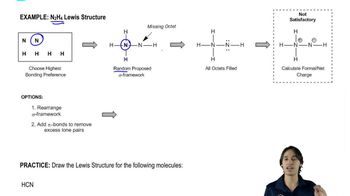
Drawing the Lewis Structure for N2H4.

Functional Groups

Functional groups are specific groups of atoms within molecules that are responsible for the characteristic chemical reactions of those molecules. They determine the properties and reactivity of organic compounds. Recognizing functional groups, such as carbonyls, alcohols, and amines, is crucial for classifying compounds and predicting their behavior in chemical reactions.
Video consigliato:
02:36
Identifying Functional Groups

Molecular Geometry

Molecular geometry refers to the three-dimensional arrangement of atoms in a molecule. It is influenced by the number of electron pairs around the central atom, which can affect bond angles and overall shape. Understanding molecular geometry is important for predicting the physical and chemical properties of compounds, as well as their interactions with other molecules.
Video consigliato:
07:44
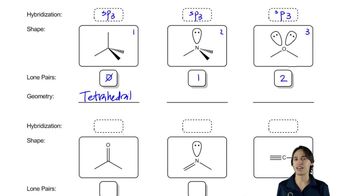
Molecular Geometry Explained.