
Ch. 2 - Acids and Bases; Functional Groups
Wade - Organic Chemistry 9th Edition
Wade9th EditionOrganic ChemistryISBN: 9780135213728Non è quello che usi tu?Cambia libro di testo
Capitolo 2, Problema 28

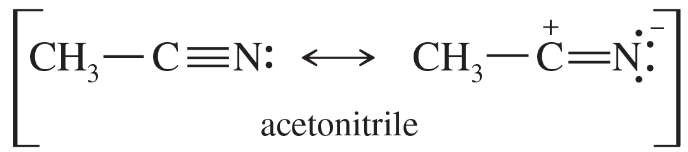
The C≡N triple bond in acetonitrile has a dipole moment of about 3.6 D and a bond length of about 1.16 Å. Calculate the amount of charge separation in this bond. How important is the charge-separated resonance form in the structure of acetonitrile?

Guida verificata passo dopo passo
1
To calculate the amount of charge separation in the C≡N bond of acetonitrile, use the formula for dipole moment: μ = q × d, where μ is the dipole moment, q is the charge separation, and d is the bond length.
Rearrange the formula to solve for q: q = μ / d.
Substitute the given values into the equation: μ = 3.6 D (Debye) and d = 1.16 Å (angstroms). Note that 1 D = 3.33564 × 10^-30 C·m and 1 Å = 10^-10 m.
Convert the dipole moment and bond length into consistent units (Coulombs and meters) before substituting them into the equation.
Discuss the importance of the charge-separated resonance form: The resonance form with charge separation contributes to the overall structure of acetonitrile, but the major contributor is the form without charge separation due to the stability of neutral molecules. The resonance form with charge separation is less stable due to the presence of formal charges.

Risposta video verificata per un problema simile:

Questa soluzione video è stata consigliata dai nostri tutor come utile per risolvere questo problema.
Durata del video:
6m

Concetti chiave

Ecco i concetti essenziali che devi comprendere per rispondere correttamente alla domanda.

Dipole Moment

The dipole moment is a measure of the separation of positive and negative charges in a molecule, indicating its polarity. It is expressed in Debye units (D) and reflects how unevenly the electrons are distributed. In acetonitrile, the dipole moment of 3.6 D suggests a significant charge separation due to the electronegativity difference between carbon and nitrogen.
Video consigliato:
01:46
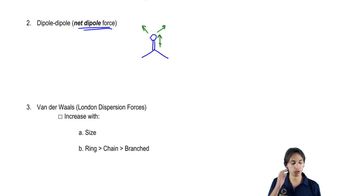
How dipole-dipole forces work.

Resonance Structures

Resonance structures are different ways of drawing the same molecule that illustrate the delocalization of electrons. In acetonitrile, the resonance forms show the potential charge separation, where the carbon atom can carry a positive charge while nitrogen carries a negative charge. These structures help in understanding the stability and reactivity of the molecule.
Video consigliato:
03:04
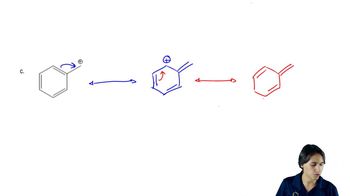
Drawing Resonance Structures

Bond Length

Bond length is the average distance between the nuclei of two bonded atoms. In acetonitrile, the bond length of the C≡N triple bond is approximately 1.16 Å, indicating a strong bond due to the overlap of atomic orbitals. Shorter bond lengths typically correlate with stronger bonds, which is crucial for understanding the stability of the molecule.
Video consigliato:
06:00
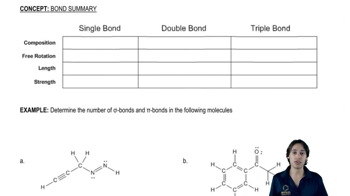
Single bonds, double bonds, and triple bonds.
Pratica correlata
Domanda del libro di testo

For each of the following compounds,

1. draw the Lewis structure.

2. show how the bond dipole moments (and those of any nonbonding pairs of electrons) contribute to the molecular dipole moment.

3. estimate whether the compound will have a large, small, or zero dipole moment.

e.

659
views
Domanda del libro di testo

Circle the functional groups in the following structures. State to which class (or classes) of compounds the structure belongs.

d. CH3CONH2

e. CH3NHCH3

f. RCOOH

2664
views
Domanda del libro di testo

For each of the following compounds,

1. draw the Lewis structure.

2. show how the bond dipole moments (and those of any nonbonding pairs of electrons) contribute to the molecular dipole moment.

3. estimate whether the compound will have a large, small, or zero dipole moment.

d.

995
views
Domanda del libro di testo

For each of the following compounds,

1. draw the Lewis structure.

2. show how the bond dipole moments (and those of any nonbonding pairs of electrons) contribute to the molecular dipole moment.

3. estimate whether the compound will have a large, small, or zero dipole moment.

a. CH3CH=NCH3

b. CH3CH2OH

c. CBr4

2466
views
Domanda del libro di testo

Circle the functional groups in the following structures. State to which class (or classes) of compounds the structure belongs.

a. CH2=CHCH2COOCH3

b. CH3OCH3

c. CH3CHO

2320
views
Domanda del libro di testo

Circle the functional groups in the following structures. State to which class (or classes) of compounds the structure belongs.

(g)

(h)

(i)

1023
views