Ch. 2 - Acids and Bases; Functional Groups
Wade - Organic Chemistry 9th Edition
Wade9th EditionOrganic ChemistryISBN: 9780135213728Non è quello che usi tu?Cambia libro di testo
Capitolo 2, Problema 1a

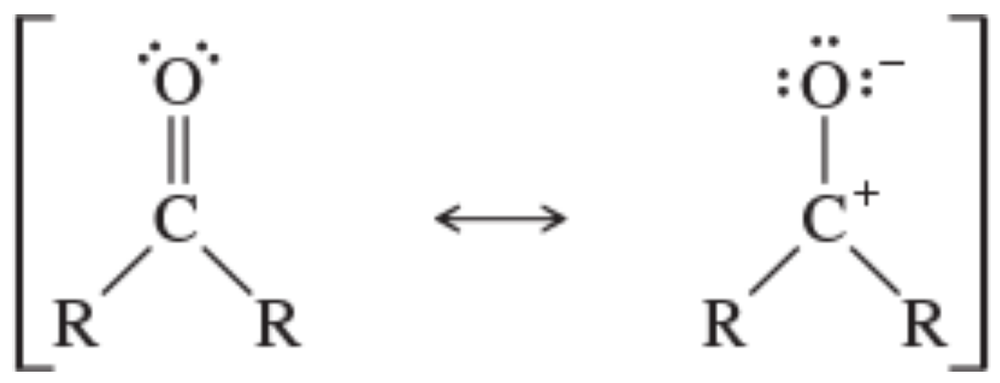
The C=O double bond has a dipole moment of about 2.4 D and a bond length of about 1.23 Å.
a. Calculate the amount of charge separation in this bond.

Guida verificata passo dopo passo
1
Understand the relationship between dipole moment (μ), charge (q), and distance (d) using the formula: μ = q × d. Here, μ is given as 2.4 D (Debye) and d is given as 1.23 Å (angstroms).
Convert the dipole moment from Debye to coulomb-meters. Recall that 1 D = 3.33564 × 10^-30 C·m.
Convert the bond length from angstroms to meters. Recall that 1 Å = 1 × 10^-10 m.
Rearrange the formula to solve for the charge (q): q = μ / d.
Substitute the converted values of μ and d into the equation to calculate the charge separation in coulombs.

Risposta video verificata per un problema simile:

Questa soluzione video è stata consigliata dai nostri tutor come utile per risolvere questo problema.
Durata del video:
1m

Concetti chiave

Ecco i concetti essenziali che devi comprendere per rispondere correttamente alla domanda.

Dipole Moment

The dipole moment is a measure of the separation of positive and negative charges in a molecule. It is a vector quantity, often expressed in Debye units (D), and is calculated as the product of the charge magnitude and the distance between the charges. In the context of a C=O bond, the dipole moment indicates the polarity of the bond due to the difference in electronegativity between carbon and oxygen.
Video consigliato:
01:46
How dipole-dipole forces work.

Bond Length

Bond length is the average distance between the nuclei of two bonded atoms. It is typically measured in angstroms (Å) and is influenced by the size of the atoms and the bond order. In a C=O double bond, the bond length is shorter than a single bond due to the increased electron sharing, which pulls the atoms closer together, affecting the dipole moment calculation.
Video consigliato:
06:00
Single bonds, double bonds, and triple bonds.

Charge Separation

Charge separation in a bond refers to the distribution of electron density between two atoms, leading to partial positive and negative charges. This concept is crucial for calculating the dipole moment, as it involves determining the effective charge difference across the bond. In a C=O bond, the charge separation arises from the higher electronegativity of oxygen compared to carbon, resulting in a partial negative charge on oxygen and a partial positive charge on carbon.
Video consigliato:
01:34
Calculating formal and net charge.