
Ch. 2 - Acids and Bases; Functional Groups
Wade - Organic Chemistry 9th Edition
Wade9th EditionOrganic ChemistryISBN: 9780135213728Non è quello che usi tu?Cambia libro di testo
Capitolo 2, Problema 40b

The following compound can become protonated on any of the three nitrogen atoms. One of these nitrogens is much more basic than the others, however.
b. Determine which nitrogen atom is the most basic.

Guida verificata passo dopo passo
1
Identify the three nitrogen atoms in the compound: Nitrogen 1 is bonded to an ethyl group and a hydrogen, Nitrogen 2 is part of an amide group, and Nitrogen 3 is part of an imine group.
Consider the electronic environment of each nitrogen atom. Nitrogen 1 is a secondary amine, Nitrogen 2 is an amide nitrogen, and Nitrogen 3 is an imine nitrogen.
Evaluate the basicity of each nitrogen. Basicity is influenced by the availability of the lone pair of electrons on the nitrogen to accept a proton.
Nitrogen 1, being part of a secondary amine, has its lone pair more available for protonation compared to Nitrogen 2 and Nitrogen 3. Amide nitrogen (Nitrogen 2) is less basic due to resonance delocalization of its lone pair with the carbonyl group. Imine nitrogen (Nitrogen 3) is also less basic due to the partial positive charge on the nitrogen from the double bond.
Conclude that Nitrogen 1 is the most basic nitrogen atom in the compound because its lone pair is not involved in resonance and is more available to accept a proton.

Risposta video verificata per un problema simile:

Questa soluzione video è stata consigliata dai nostri tutor come utile per risolvere questo problema.
Durata del video:
6m

Concetti chiave

Ecco i concetti essenziali che devi comprendere per rispondere correttamente alla domanda.

Basicity of Nitrogen Atoms

Basicity refers to the ability of a compound to accept protons (H+ ions). In nitrogen-containing compounds, the basicity is influenced by the availability of the lone pair of electrons on the nitrogen atom. The more available the lone pair, the stronger the base. In this case, the nitrogen atom's environment, including steric and electronic effects, will determine its basicity.
Video consigliato:
Percorso guidato
1:45
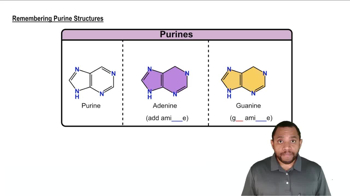
Nitrogenous Bases Concept 3

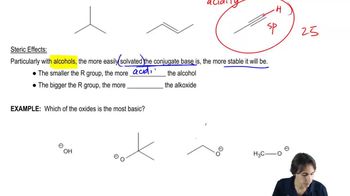
Steric Hindrance

Steric hindrance occurs when the spatial arrangement of atoms in a molecule prevents certain interactions, such as protonation. In the context of nitrogen atoms, if a nitrogen is surrounded by bulky groups, it may be less accessible for protonation, thus affecting its basicity. Understanding the spatial arrangement of the nitrogen atoms in the given compound is crucial for determining which is the most basic.
Video consigliato:
02:53
Understanding steric effects.

Resonance Effects

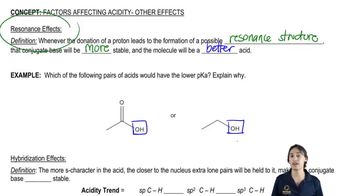
Resonance refers to the delocalization of electrons within a molecule, which can stabilize or destabilize certain structures. In nitrogen-containing compounds, resonance can affect the electron density on nitrogen atoms, influencing their basicity. If a nitrogen atom is involved in resonance with a carbonyl or other electronegative groups, it may be less basic due to reduced electron availability for protonation.
Video consigliato:
03:32
Understanding Resonance Effects