Ch. 2 - Acids and Bases; Functional Groups
Wade - Organic Chemistry 9th Edition
Wade9th EditionOrganic ChemistryISBN: 9780135213728Non è quello che usi tu?Cambia libro di testo
Capitolo 2, Problema 13a,b,c

Write equations for the following acid–base reactions. Label the conjugate acids and bases, and show any inductive stabilization. Predict whether the equilibrium favors the reactants or products. Try to do this without using a table of pKa values, but if you need a hint, you can consult Appendix 4.
a. CH3CH2OH + CH3NH−
b. F3CCOONa + Br3C—COOH
c. CH3OH + H2SO4

Guida verificata passo dopo passo
1
Identify the acid and base in each reaction. For reaction (a), CH3CH2OH is the acid and CH3NH− is the base. For reaction (b), Br3C—COOH is the acid and F3CCOONa is the base. For reaction (c), H2SO4 is the acid and CH3OH is the base.
Write the chemical equation for each reaction. For example, in reaction (a), the equation is CH3CH2OH + CH3NH− → CH3CH2O− + CH3NH2.
Label the conjugate acid and base in each reaction. In reaction (a), CH3CH2O− is the conjugate base and CH3NH2 is the conjugate acid.
Consider the inductive effects that might stabilize the conjugate base. For instance, in reaction (b), the electron-withdrawing effect of the trifluoromethyl group in F3CCOONa can stabilize the conjugate base.
Predict the direction of the equilibrium by comparing the acidity of the reactants and products. Generally, the equilibrium will favor the side with the weaker acid and base. Use the pKa values from the appendix to assist in this prediction if needed.

Risposta video verificata per un problema simile:

Questa soluzione video è stata consigliata dai nostri tutor come utile per risolvere questo problema.
Durata del video:
7m

Concetti chiave

Ecco i concetti essenziali che devi comprendere per rispondere correttamente alla domanda.

Acid-Base Reaction Mechanism

Acid-base reactions involve the transfer of protons (H+) between reactants. The acid donates a proton, becoming its conjugate base, while the base accepts a proton, forming its conjugate acid. Understanding the mechanism helps predict the direction of equilibrium based on the relative strengths of acids and bases involved.
Video consigliato:
02:49
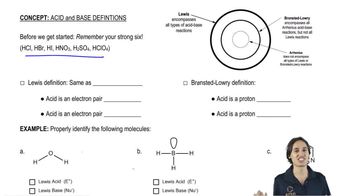
The Lewis definition of acids and bases.

Conjugate Acid-Base Pairs

In acid-base chemistry, conjugate acid-base pairs are related by the gain or loss of a proton. The conjugate acid is formed when a base gains a proton, and the conjugate base is formed when an acid loses a proton. Identifying these pairs is crucial for labeling and understanding the stability and reactivity of the species in a reaction.
Video consigliato:
Percorso guidato
2:56
Base Pairing Concept 1

Inductive Effect and Stabilization

The inductive effect refers to the electron-withdrawing or electron-donating properties of substituents, which can stabilize or destabilize ions. Electron-withdrawing groups can stabilize negative charges by dispersing them, affecting the equilibrium position. Recognizing inductive effects helps predict whether reactants or products are favored in a reaction.
Video consigliato:
01:47
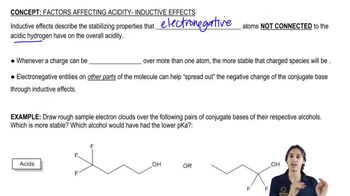
Understanding the Inductive Effect.
Pratica correlata
Domanda del libro di testo

Rank the following acids in decreasing order of their acid strength. In each case, explain why the previous compound should be a stronger acid than the one that follows it.

2622
views
1
rank

Domanda del libro di testo

Write equations for the following acid–base reactions. Label the conjugate acids and bases, and show any inductive stabilization. Predict whether the equilibrium favors the reactants or products. Try to do this without using a table of pKa values, but if you need a hint, you can consult Appendix 4.

g. NaOCH2CH3 + Cl2CHCH2OH

h. H2Se + NaNH2

i. CH3CHFCOOH + FCH2CH2COO–

797
views
Domanda del libro di testo

Write equations for the following acid–base reactions. Label the conjugate acids and bases, and show any inductive stabilization. Predict whether the equilibrium favors the reactants or products. Try to do this without using a table of pKa values, but if you need a hint, you can consult Appendix 4.

j. CF3CH2O– + FCH2CH2OH

1059
views
Domanda del libro di testo

Ethanol, methylamine, and acetic acid are all amphoteric, reacting as either acids or bases depending on the conditions.

b. Rank ethanol, methylamine, and acetic acid in decreasing order of basicity. In each case, show the equation for the reaction with a generic acid (HA) to give the conjugate acid.

1504
views
Domanda del libro di testo

For each of the following reactions, suggest which solvent(s) would be compatible with the acids and bases involved. (We will ignore any other possible reactions for now.) Your choices of solvents are pentane, diethyl ether, ethanol, water, and ammonia. Refer to Appendix 4 for any needed values of pKa, or estimate them. 

c.

d.

948
views
Domanda del libro di testo

For each of the following reactions, suggest which solvent(s) would be compatible with the acids and bases involved. (We will ignore any other possible reactions for now.) Your choices of solvents are pentane, diethyl ether, ethanol, water, and ammonia. Refer to Appendix 4 for any needed values of pKa, or estimate them.

a. CH3Li + H—C≡C—H → CH4 + H—C≡CLi

b. CH3Li + (CH3)3C—OH → CH4 + (CH3)3C—OLi

2925
views
1
rank