Ch.10 - Structure and Synthesis of Alcohols
Wade - Organic Chemistry 9th Edition
Wade9th EditionOrganic ChemistryISBN: 9780135213728Non è quello che usi tu?Cambia libro di testo
Capitolo 10, Problema 42e

Complete the following acid–base reactions. In each case, indicate whether the equilibrium favors the reactants or the products, and explain your reasoning.
(e) (CH3)3C–O– + CH3CH2OH ⇌

Guida verificata passo dopo passo
1
Step 1: Identify the acid and base on both sides of the reaction. In this case, (CH3)3C—O⁻ is the base, and CH3CH2OH is the acid. The conjugate acid and base will form on the product side.
Step 2: Determine the conjugate acid and conjugate base. The conjugate acid of (CH3)3C—O⁻ is (CH3)3C—OH, and the conjugate base of CH3CH2OH is CH3CH2O⁻.
Step 3: Compare the acidity of the acids involved. (CH3)3C—OH is a weaker acid compared to CH3CH2OH because the bulky tert-butyl group stabilizes the conjugate base (CH3)3C—O⁻ through steric hindrance and inductive effects.
Step 4: Use the pKa values to predict the direction of equilibrium. CH3CH2OH has a lower pKa (stronger acid) compared to (CH3)3C—OH, so the equilibrium will favor the formation of the weaker acid and weaker base, which are (CH3)3C—OH and CH3CH2O⁻.
Step 5: Conclude that the equilibrium favors the products because the reaction moves toward the side with the weaker acid and weaker base, which are more stable.

Risposta video verificata per un problema simile:

Questa soluzione video è stata consigliata dai nostri tutor come utile per risolvere questo problema.
Durata del video:
6m

Concetti chiave

Ecco i concetti essenziali che devi comprendere per rispondere correttamente alla domanda.

Acid-Base Reactions

Acid-base reactions involve the transfer of protons (H+) between reactants. In organic chemistry, acids are proton donors, while bases are proton acceptors. Understanding the nature of the acids and bases involved is crucial for predicting the direction of the equilibrium and the products formed in the reaction.
Video consigliato:
02:49
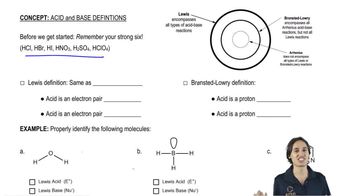
The Lewis definition of acids and bases.

Equilibrium Position

The position of equilibrium in a chemical reaction indicates whether the reactants or products are favored. This can be influenced by factors such as the strength of the acids and bases involved, the stability of the resulting products, and the reaction conditions. Analyzing these factors helps determine the predominant species at equilibrium.
Video consigliato:
Percorso guidato
2:49
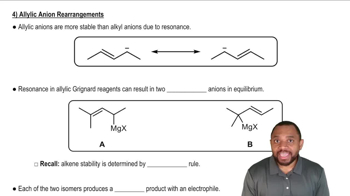
Reactions at the Allylic Position Concept 5

Stability of Conjugate Acids and Bases

The stability of the conjugate acids and bases formed during an acid-base reaction plays a significant role in determining the equilibrium position. A more stable conjugate base corresponds to a stronger acid, and vice versa. Evaluating the stability of these species can provide insight into which side of the reaction is favored.
Video consigliato:
04:31
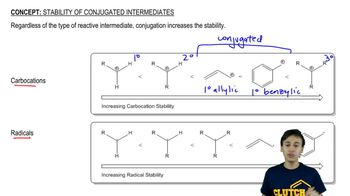
Stability of Conjugated Intermediates