Ch.10 - Structure and Synthesis of Alcohols
Wade - Organic Chemistry 9th Edition
Wade9th EditionOrganic ChemistryISBN: 9780135213728Non è quello che usi tu?Cambia libro di testo
Capitolo 10, Problema 52f

Devise a synthesis for each compound, starting with methylenecyclohexane and any other reagents you need.
f. 1-(phenylmethyl)cyclohexanol

Guida verificata passo dopo passo
1
Step 1: Begin with methylenecyclohexane as the starting material. Perform a hydroboration-oxidation reaction to convert the alkene into an alcohol. Use BH₃·THF (borane-tetrahydrofuran complex) followed by H₂O₂ (hydrogen peroxide) and NaOH (sodium hydroxide) to yield cyclohexanol.
Step 2: Prepare benzyl bromide (C₆H₅CH₂Br) as the source of the phenylmethyl group. Benzyl bromide can be obtained by reacting toluene (C₆H₅CH₃) with bromine (Br₂) in the presence of light or a radical initiator.
Step 3: Perform a Williamson ether synthesis to attach the phenylmethyl group to cyclohexanol. First, convert cyclohexanol into cyclohexoxide by treating it with a strong base such as NaH (sodium hydride). Then, react cyclohexoxide with benzyl bromide to form 1-(phenylmethyl)cyclohexanol.
Step 4: Ensure stereochemical control during the synthesis, as the reaction may produce a mixture of stereoisomers. If necessary, use purification techniques such as recrystallization or chromatography to isolate the desired product.
Step 5: Verify the structure of the final product, 1-(phenylmethyl)cyclohexanol, using spectroscopic methods such as NMR (nuclear magnetic resonance) and IR (infrared spectroscopy) to confirm the presence of the phenylmethyl group and hydroxyl functionality.

Risposta video verificata per un problema simile:

Questa soluzione video è stata consigliata dai nostri tutor come utile per risolvere questo problema.
Durata del video:
3m

Concetti chiave

Ecco i concetti essenziali che devi comprendere per rispondere correttamente alla domanda.

Synthesis in Organic Chemistry

Synthesis in organic chemistry refers to the process of constructing complex organic compounds from simpler ones through a series of chemical reactions. Understanding the synthesis pathway is crucial for determining the necessary reagents and conditions required to achieve the desired product. This involves knowledge of functional group transformations, reaction mechanisms, and the reactivity of different organic compounds.
Video consigliato:
00:56
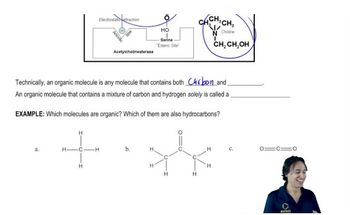
What is an organic molecule?

Reagents and Reaction Mechanisms

Reagents are substances used in chemical reactions to facilitate the transformation of reactants into products. Each reagent can influence the reaction pathway and the final structure of the compound. Familiarity with common reagents and their mechanisms—such as nucleophilic substitutions, electrophilic additions, and reductions—is essential for planning a successful synthesis.
Video consigliato:
06:50
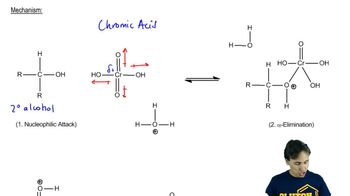
Jones Reagent Mechanism

Functional Groups and Their Transformations

Functional groups are specific groups of atoms within molecules that determine the chemical properties and reactions of those molecules. In the synthesis of 1-(phenylmethyl)cyclohexanol, recognizing the functional groups present in methylenecyclohexane and the target compound is vital. This knowledge allows chemists to identify appropriate reactions that can introduce or modify these functional groups to achieve the desired compound.
Video consigliato:
02:36
Identifying Functional Groups
Pratica correlata
Domanda del libro di testo

Compare the properties of propan-2-ol (I) and the hexafluoro analog (II).

(a) Compound II has almost triple the molecular weight of I, but II has a lower boiling point. Explain.

547
views

Domanda del libro di testo

Compounds containing deuterium (D = 2H) are useful for kinetic studies and metabolic studies with new pharmaceuticals. One way to introduce deuterium is by using the reagent LiAlD4, equivalent in reactivity to LiAlH4. Show how to make these deuterium-labeled compounds, using LiAlD4 and D2O as your sources of deuterium, and any non-deuterated starting materials you wish.

(b) CH3CD2OH

843
views
Domanda del libro di testo

Devise a synthesis for each compound, starting with methylenecyclohexane and any other reagents you need.

c. 1-(hydroxymethyl)cyclohexanol

901
views
Domanda del libro di testo

Devise a synthesis for each compound, starting with methylenecyclohexane and any other reagents you need.

b. cyclohexylmethanol

1504
views
Domanda del libro di testo

Compounds containing deuterium (D = 2H) are useful for kinetic studies and metabolic studies with new pharmaceuticals. One way to introduce deuterium is by using the reagent LiAlD4, equivalent in reactivity to LiAlH4. Show how to make these deuterium-labeled compounds, using LiAlD4 and D2O as your sources of deuterium, and any non-deuterated starting materials you wish.

a. CH3CHDOH

1387
views
Domanda del libro di testo

Devise a synthesis for each compound, starting with methylenecyclohexane and any other reagents you need.

d. trans-2-methylcyclohexanol

1016
views