Ch.10 - Structure and Synthesis of Alcohols
Wade - Organic Chemistry 9th Edition
Wade9th EditionOrganic ChemistryISBN: 9780135213728Non è quello che usi tu?Cambia libro di testo
Capitolo 10, Problema 51a-d

Propose structures for intermediates and products (A) through (D).
Flowchart illustrating chemical reactions and proposed structures for intermediates and products labeled A through K.

Guida verificata passo dopo passo
1
Step 1: Begin with 1-bromobutane. React it with KOH and H2O to perform an elimination reaction, forming but-1-ene (A). This reaction removes the bromine atom and introduces a double bond.
Step 2: Treat but-1-ene (A) with sodium metal (Na). This reaction generates a sodium alkoxide intermediate (B), which is highly reactive.
Step 3: React intermediate (B) with ethyl bromide (CH3CH2Br) to perform an alkylation reaction, forming pentane (C). This step involves the nucleophilic substitution of the bromine atom in ethyl bromide.
Step 4: React 1-bromobutane with magnesium in ether to form a Grignard reagent (D). This reagent is highly nucleophilic and can react with aldehydes or ketones.
Step 5: Use the Grignard reagent (D) to react with CH3(CH2)3CHO (butanal) in the presence of H3O+ to form a secondary alcohol (E). This reaction involves nucleophilic addition of the Grignard reagent to the carbonyl group of butanal.

Risposta video verificata per un problema simile:

Questa soluzione video è stata consigliata dai nostri tutor come utile per risolvere questo problema.
Durata del video:
5m

Concetti chiave

Ecco i concetti essenziali che devi comprendere per rispondere correttamente alla domanda.

Reaction Mechanisms

Understanding reaction mechanisms is crucial in organic chemistry as they describe the step-by-step process by which reactants transform into products. This includes identifying intermediates, transition states, and the movement of electrons. A clear grasp of mechanisms helps predict the structure of intermediates and products based on the starting materials and conditions.
Video consigliato:
02:16
Heck Reaction Mechanism

Functional Groups

Functional groups are specific groups of atoms within molecules that are responsible for the characteristic chemical reactions of those molecules. Recognizing functional groups is essential for predicting how compounds will behave in reactions, as they dictate the reactivity and properties of the organic molecules involved in the proposed structures.
Video consigliato:
02:36
Identifying Functional Groups

Stereochemistry

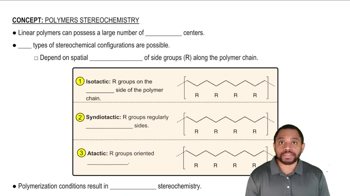
Stereochemistry involves the study of the spatial arrangement of atoms in molecules and how this affects their chemical behavior. It is important for understanding isomerism, including enantiomers and diastereomers, which can have vastly different properties. In proposing structures for intermediates and products, considering stereochemistry ensures accurate representation of the molecules' three-dimensional shapes.
Video consigliato:
Percorso guidato
1:38
Polymer Stereochemistry Concept 1