Ch.10 - Structure and Synthesis of Alcohols
Wade - Organic Chemistry 9th Edition
Wade9th EditionOrganic ChemistryISBN: 9780135213728Non è quello che usi tu?Cambia libro di testo
Capitolo 10, Problema 57c,d

Show how this 1° alcohol can be made from the following:
Structural formula of a 1° alcohol with a hydroxyl group and a five-membered carbon ring.
(c) a 7-carbon aldehyde
(d) a carboxylic acid

Guida verificata passo dopo passo
1
Step 1: Identify the target molecule, which is a primary alcohol with a cyclopentyl group attached to a 2-carbon chain ending in a hydroxyl group (-OH).
Step 2: For part (c), starting from a 7-carbon aldehyde, use a reduction reaction. The aldehyde can be reduced to a primary alcohol using a reducing agent such as sodium borohydride (NaBH₄) or lithium aluminum hydride (LiAlH₄). Write the reaction as: R2-C=O+HNaBH4→R2-CH-OH.
Step 3: For part (d), starting from a carboxylic acid, first convert the carboxylic acid to an aldehyde. This can be achieved using a mild reducing agent such as DIBAL-H (diisobutylaluminum hydride) under controlled conditions. Write the reaction as: R-COOH+DIBAL→R-CHO.
Step 4: After obtaining the aldehyde from the carboxylic acid, proceed with the reduction step as described in Step 2 to convert the aldehyde into the primary alcohol.
Step 5: Verify the structure of the final product to ensure it matches the target molecule, confirming that the cyclopentyl group and the hydroxyl group are correctly positioned.

Risposta video verificata per un problema simile:

Questa soluzione video è stata consigliata dai nostri tutor come utile per risolvere questo problema.
Durata del video:
3m

Concetti chiave

Ecco i concetti essenziali che devi comprendere per rispondere correttamente alla domanda.

Alcohol Synthesis

Alcohols can be synthesized through various methods, including reduction reactions. A primary (1°) alcohol can be formed by reducing an aldehyde or a carboxylic acid. Understanding the reduction process, which involves the addition of hydrogen or the removal of oxygen, is crucial for converting carbonyl compounds into alcohols.
Video consigliato:
02:26
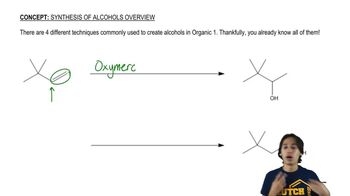
Forming alcohols through Oxymercuration-Reduction.

Aldehyde Reduction

Aldehydes can be reduced to primary alcohols using reducing agents such as lithium aluminum hydride (LiAlH4) or sodium borohydride (NaBH4). This reaction involves the nucleophilic attack of the hydride ion on the carbonyl carbon, leading to the formation of the alcohol. Recognizing the structure and reactivity of aldehydes is essential for this transformation.
Video consigliato:
01:34
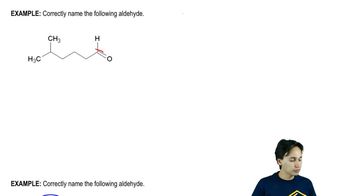
Name the aldehyde

Carboxylic Acid Reduction

Carboxylic acids can be reduced to primary alcohols through a similar process, typically requiring stronger reducing agents like LiAlH4. The reduction involves the conversion of the carboxyl group (-COOH) to a hydroxyl group (-OH), resulting in the formation of a primary alcohol. Understanding the mechanism of this reduction is vital for synthesizing alcohols from carboxylic acids.
Video consigliato:
04:20
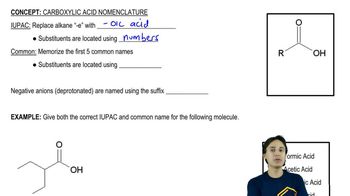
Carboxylic Acids Nomenclature